
A late shipment does more than miss a delivery window. It can delay production, increase storage costs, trigger customer complaints, or hold up customs release at the destination. That is why understanding what is international freight transport matters for importers, exporters, and supply chain teams managing cargo across borders.
International freight transport is the movement of goods from one country to another by air, sea, road, rail, or a combination of these modes. It includes far more than the physical trip. In practice, it also covers booking cargo space, packing standards, route planning, customs documentation, regulatory compliance, cargo handling, insurance, and final delivery coordination. For businesses shipping to and from markets such as India, the UAE, and other global trade lanes, freight transport is a logistics process that must be managed carefully from origin to destination.
What Is International Freight Transport and Why Does It Matter?
At its core, international freight transport connects manufacturers, suppliers, distributors, retailers, and end customers in different countries. Without it, global trade slows down fast. Raw materials do not reach factories on time, finished goods miss launch dates, and inventory planning becomes harder to control.
For businesses, the value is not simply that cargo moves. It is that cargo moves in a way that fits the shipment’s commercial priority. Some goods need speed. Some need lower landed cost. Some need special handling for temperature, dimensions, fragility, or value. International freight transport gives companies multiple ways to move goods, but each option comes with trade-offs in cost, transit time, risk, and documentation.
That is where freight forwarding and logistics planning become especially important. A shipment may look simple on paper, but once customs requirements, port schedules, carrier capacity, inland transport, and local regulations are involved, execution becomes more complex.
How International Freight Transport Works
Most cross-border shipments follow a sequence, even though the details vary by cargo type and route. The process usually begins with cargo assessment. Weight, dimensions, commodity type, Incoterms, origin, destination, and urgency all affect the shipping plan.
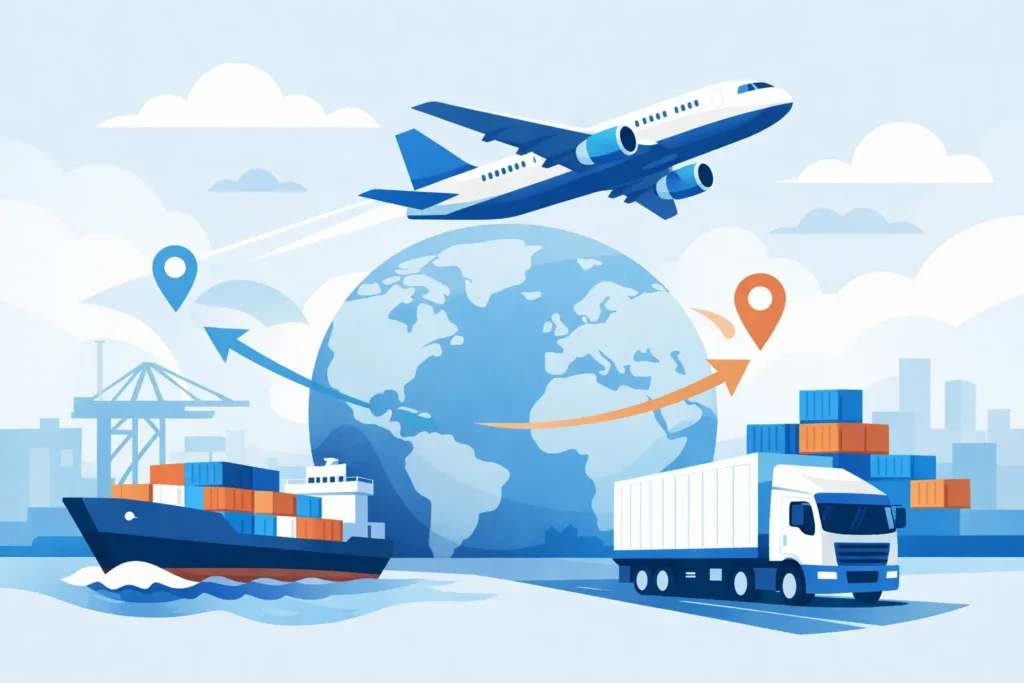
The next step is mode selection. Air freight is often chosen for time-sensitive or high-value cargo. Ocean freight is commonly used for larger volumes and cost-sensitive shipments. Land freight supports regional movement and inland connections, while multimodal shipping combines two or more methods to balance speed and cost.
Once the mode is selected, the shipment is booked with a carrier or through a freight forwarder. Documentation is prepared, including the commercial invoice, packing list, transport document, and any permits or certificates required for export or import. Customs clearance then takes place at origin, destination, or both, depending on the route and transaction terms.
After departure, the cargo is tracked through transit milestones. At arrival, import customs clearance, port or airport handling, duty and tax processing, and final delivery arrangements complete the cycle. If there is warehousing, consolidation, deconsolidation, or specialized cargo handling involved, those services are built into the shipment plan.
The Main Modes of International Freight Transport
Air freight
Air freight is the fastest option for international cargo movement. It is often used for urgent spare parts, electronics, pharmaceuticals, high-value products, and goods with short shelf life. The main advantage is speed, but the cost per kilogram is higher than ocean freight. Size and weight restrictions can also limit suitability for oversized cargo.
For businesses trying to reduce lead times or protect sales during supply shortages, air freight can be the right decision even at a premium. The question is whether the commercial value of faster delivery outweighs the additional transport cost.
Ocean freight
Ocean freight remains the most common option for global trade, especially for full container load and less than container load shipments. It is generally the most economical choice for larger volumes and non-urgent cargo. It also supports specialized movements such as break bulk, RORO, and project cargo.
The trade-off is transit time. Ocean schedules are slower, and shipments can be affected by port congestion, vessel rollovers, seasonal demand, and transshipment delays. Still, for many importers and exporters, ocean freight provides the best balance of cost and capacity.
Land freight
Land freight plays a major role in cross-border and domestic legs of international shipping. It connects factories, warehouses, ports, airports, and final destinations. In some trade corridors, road transport can serve as the primary international mode. In others, it supports first-mile and last-mile delivery.
The reliability of land transport often affects the entire shipment timeline. Even when cargo travels by sea or air internationally, poor inland coordination can create avoidable delays.
Customs Is a Major Part of the Job
One reason businesses ask what is international freight transport is that they assume it means only moving goods. In reality, customs compliance is just as critical as transportation itself.
Every shipment entering or leaving a country must meet documentation and regulatory requirements. Product classification, declared value, country of origin, import permits, duties, taxes, and restricted goods rules all influence customs clearance. Errors in paperwork can lead to inspections, storage charges, shipment holds, or penalties.
This is especially relevant for businesses shipping through India and the UAE, where efficient customs handling can make a noticeable difference in cargo flow. A well-prepared shipment reduces delays and helps control total landed cost.
What Affects Cost in International Freight Transport?
Shipping cost is never based on distance alone. Several factors shape the final rate, and understanding them helps businesses plan more accurately.
The most obvious are cargo weight and volume. Air freight often uses chargeable weight, while ocean freight may depend on container size or cubic measurement. The shipping mode matters, but so do fuel costs, carrier demand, seasonality, and route capacity.
Customs duties, taxes, terminal handling charges, documentation fees, trucking, warehousing, insurance, and delivery requirements can also add to the total. Specialized cargo such as oversized machinery, vehicles, dangerous goods, or fragile items usually requires additional handling and pricing.
This is why the cheapest freight quote is not always the most cost-effective option. A lower base rate can be offset by delays, poor coordination, or missing services that create extra charges later.
Why Businesses Use Freight Forwarders
International shipping has too many moving parts for many businesses to manage efficiently on their own, especially when dealing with multiple carriers, customs authorities, and destination requirements. Freight forwarders help organize the shipment from start to finish.
A capable forwarder assesses the cargo, recommends the most suitable mode, arranges bookings, manages documents, coordinates customs clearance, and handles communication across the shipment chain. For companies shipping regularly, this support improves consistency and reduces internal workload. For companies shipping occasionally, it provides guidance through unfamiliar rules and procedures.
The best support is not one-size-fits-all. A time-critical air shipment, a consolidated LCL load, a luxury vehicle move, and an oversized project cargo shipment all require different planning. That is where practical experience matters.
Common Challenges in International Freight Transport
No matter how established the route is, international freight transport always involves variables. Weather disruptions, port congestion, customs inspections, documentation errors, capacity shortages, and inland delivery delays can all affect shipment timing.
The solution is not to assume problems will never happen. It is to build a shipping plan that anticipates them. That means accurate paperwork, realistic transit expectations, cargo protection, clear communication, and route planning that matches the business objective.
For example, choosing ocean freight for cost savings may be sensible for replenishment stock, but not for goods tied to a launch deadline. Similarly, consolidating cargo can reduce spend, but it may add handling time. Good logistics decisions usually come down to priorities, not fixed rules.
Choosing the Right International Freight Transport Strategy
The right shipping strategy depends on what you are moving, where it is going, when it must arrive, and how much flexibility your supply chain allows. A manufacturer may prioritize reliability and recurring schedule control. An automotive client may need protected handling for vehicles. A project cargo shipper may need route surveys, heavy-lift coordination, and customs planning long before the cargo moves.
For businesses moving freight between India, the UAE, and international markets, it helps to work with a logistics partner that understands both the transport side and the customs side. That combination reduces friction and gives businesses clearer control over transit, cost, and compliance. Companies such as Mass Freight Forwarding support this by aligning mode selection, documentation, and cargo handling with the specific shipment rather than forcing every move into the same process.
International freight transport is not just about getting goods from point A to point B. It is about moving cargo in a way that protects timelines, controls cost, and keeps trade flowing with fewer surprises. When the shipping plan fits the cargo and the route, the whole supply chain works better.
