
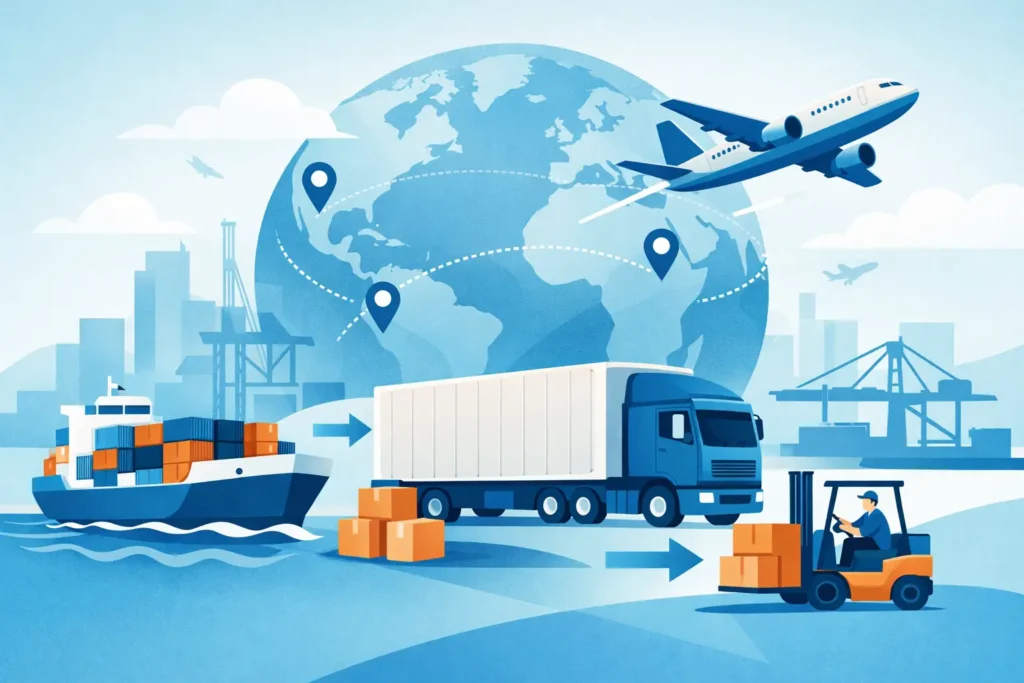
A shipment can look straightforward on paper and still go off track once it hits a port, an airport, or a customs checkpoint. That is why international freight forwarding services matter. For importers, exporters, and supply chain teams, the real value is not just moving cargo from origin to destination – it is coordinating every handoff, document, regulation, and timing risk that comes with cross-border trade.
For many businesses, freight forwarding becomes most relevant when shipping volumes grow, trade lanes become more complex, or delays start affecting customers and cash flow. A missed filing, a poor routing choice, or weak cargo handling can turn a routine shipment into a costly problem. The right forwarding partner helps prevent that by managing the shipment as an operational process, not just a booking.
What international freight forwarding services actually cover
International freight forwarding services are often misunderstood as basic transport booking. In practice, they cover a much wider scope. A freight forwarder plans the shipment, selects the most suitable mode, coordinates with carriers, prepares or manages shipping documents, supports customs clearance, and monitors cargo through transit until delivery.
That scope can include air freight for urgent cargo, ocean freight for larger or lower-cost moves, and land transport to connect factories, ports, airports, and final delivery points. It may also include warehousing, cargo consolidation, marine insurance, packing support, cargo lashing, project logistics, and door-to-door delivery.
The difference matters because transport itself is only one part of the job. International shipping usually involves multiple stakeholders – carriers, port operators, customs authorities, trucking partners, warehouses, and consignees. Without coordination, delays build quickly. A forwarder’s role is to keep those moving parts aligned.
Why businesses rely on international freight forwarding services
The main reason is control. Cross-border shipping involves variables that businesses cannot always manage internally, especially when shipping to or from markets with strict customs procedures or changing compliance requirements. Forwarders help reduce that friction.
Cost control is another factor, but this is where expectations need to be realistic. The lowest freight rate does not always create the lowest total landed cost. Ocean freight may look cheaper than air, for example, but if slower transit creates stockouts or production delays, the savings can disappear. In other cases, consolidating cargo through LCL groupage may reduce immediate spend, yet it may add handling time compared with full-container shipping. Good forwarding support weighs those trade-offs instead of pushing one mode for every shipment.
Businesses also rely on forwarders for visibility and problem-solving. When a port is congested, documentation needs correction, or a shipment requires rerouting, experience matters. The issue is rarely whether problems happen. The issue is how quickly they are identified and handled.
Choosing the right mode for the shipment
Every cargo profile has a best-fit transport method, and the answer depends on urgency, dimensions, cost targets, and destination requirements.
Air freight
Air freight is best suited for time-sensitive cargo, high-value goods, spare parts, urgent replenishment orders, and items where speed justifies the higher cost. It reduces transit time significantly, but it is more expensive and more sensitive to dimensional weight rules and airline restrictions.
Ocean freight
Ocean freight remains the standard for larger international shipments and cost-efficient long-distance transport. It works well for full container loads, machinery, raw materials, consumer goods, and recurring trade volumes. It offers lower unit costs but requires longer planning cycles and stronger inventory management.
Land freight and multimodal planning
Land freight often connects the international leg to final delivery. In some regional lanes, it may also be the primary mode. More often, it is part of a multimodal plan that combines trucking with ocean or air. This is where forwarding expertise becomes practical – the shipment does not move as isolated segments, but as one coordinated chain.
Customs is where many shipments slow down
Freight movement is only part of international trade. Customs compliance is often the point where shipments either move smoothly or stall.
Accurate invoices, packing lists, declarations, tariff classifications, and supporting permits all affect clearance timelines. Even small errors can trigger inspections, storage costs, or delivery delays. This is especially relevant in active trade corridors such as India and the UAE, where documentation standards, import conditions, and procedural timing need close attention.
A capable freight forwarding partner does more than submit paperwork. They help prepare the shipment so customs requirements are addressed before cargo arrives. That distinction saves time because prevention is always easier than correction after the shipment is held.
Specialized cargo needs specialized handling
Not every shipment fits standard pallets and cartons. Some businesses move oversized project cargo, industrial equipment, automotive units, or fragile high-value goods that need route studies, loading plans, lashing, special equipment, or RORO and break bulk solutions.
This is where generic shipping support starts to fall short. Specialized cargo requires operational judgment, not just administrative coordination. A vehicle shipment, for example, may involve export preparation, secure loading, customs documentation, and destination handling that differs entirely from general commercial freight. Project cargo has its own planning demands, especially when dimensions, lifting requirements, or site delivery constraints are involved.
When evaluating providers, businesses should look beyond whether a company offers the service. The better question is whether it can execute that service reliably under real operating conditions.
What to look for in a freight forwarding partner
Not every provider offers the same level of control, communication, or route expertise. The right fit depends on your cargo and trade lanes, but some factors are consistently important.
Experience with customs clearance is critical. So is the ability to offer more than one transport mode. If a forwarder only sells one path, the recommendation may reflect limitation rather than suitability. Businesses should also assess communication standards. Shipment visibility, response time, and escalation handling all affect day-to-day operations.
Geographic strength matters too. Companies shipping between India, the UAE, and global markets benefit from partners that understand those corridors directly rather than through distant intermediaries. Operational presence and route familiarity usually lead to faster decisions and fewer handoff issues.
A provider such as Mass Freight Forwarding is built around that practical advantage – combining freight movement, customs handling, and tailored logistics support across India, the UAE, and broader international trade lanes.
When door-to-door service makes more sense
Some shipments are best managed port to port or airport to airport, especially when the shipper has its own inland logistics resources. But many businesses prefer door-to-door service because it reduces coordination points and puts one party in charge of the shipment from pickup through final delivery.
That model can be especially useful for SMEs, procurement teams with lean staffing, and customers shipping high-value goods or vehicles. It also helps when destination-side procedures are unfamiliar. Door-to-door service is not automatically the cheapest option in every case, but it often creates better control and fewer delays because responsibility is more centralized.
The cost question: cheaper is not always better
Freight decisions are often driven by price, and that is reasonable. Shipping costs affect margins. But choosing purely on rate can create bigger downstream expenses.
For example, a lower quote may exclude destination charges, customs support, storage risk, insurance guidance, or delivery coordination. Another provider may appear more expensive but include stronger planning, fewer delays, and better cargo protection. The right comparison is total shipping outcome, not just headline freight cost.
The same logic applies to packaging and cargo security. Proper lashing, documentation accuracy, and cargo marine insurance can feel optional until a shipment is damaged, delayed, or disputed. At that point, the lowest-cost approach often becomes the most expensive one.
Freight forwarding works best as a business support function
The strongest logistics partnerships do more than move freight. They support planning. That means helping businesses choose booking windows, manage recurring volumes, prepare for seasonal swings, and balance speed against budget.
For importers and exporters with regular shipments, this can improve purchasing discipline and inventory flow. For project-based cargo, it reduces surprises. For individuals shipping vehicles or large personal cargo internationally, it provides structure in a process that can otherwise feel complicated very quickly.
Reliable forwarding support is not about making international shipping look simple. It is about making it manageable, predictable, and better aligned with business goals. When cargo is moving across borders, that kind of execution protects more than a shipment – it protects timelines, customer commitments, and trust.
If your freight keeps crossing markets, the smartest next step is not just finding space on a vessel or flight. It is working with a logistics partner that can keep the entire movement under control from the first document to the final delivery.
