
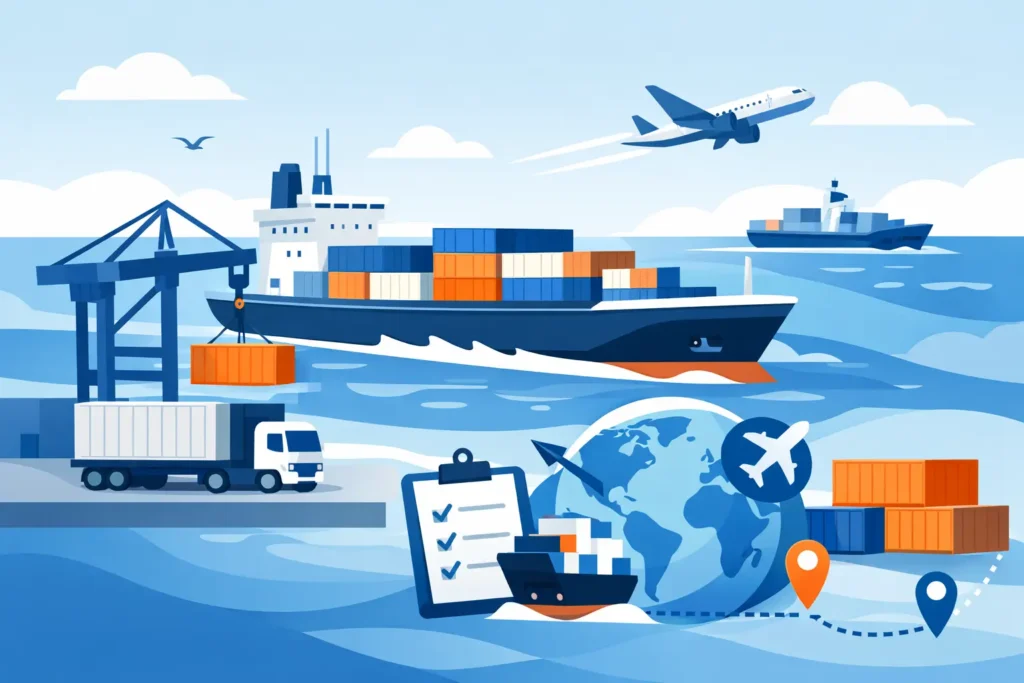
A delayed container can stall production, miss a retail launch, or add storage charges before cargo even reaches your warehouse. That is why a clear answer to what is ocean freight forwarding matters for importers, exporters, and supply chain teams moving goods across busy trade lanes.
Ocean freight forwarding is the coordination and management of cargo shipped by sea from origin to destination. A freight forwarder does not usually operate the vessel itself. Instead, the forwarder plans the shipment, books cargo space with carriers, prepares shipping documents, coordinates pickup and delivery, supports customs clearance, and helps manage the many handoffs that happen between supplier, port, shipping line, customs authorities, and final consignee.
For businesses shipping to and from India, the UAE, and global markets, this role is more than administrative. It reduces friction in a process that involves schedules, port cutoffs, compliance rules, container availability, and cost control. When done well, ocean freight forwarding helps cargo move with fewer surprises.
What is ocean freight forwarding in practical terms?
In practical terms, ocean freight forwarding is shipment management. If a manufacturer in India needs to send goods to a buyer in the UAE, or a trading company in Dubai needs to import containers from Asia, the forwarder becomes the operational link between all parties involved.
That work starts before the cargo reaches the port. The forwarder reviews the shipment details, including cargo type, weight, dimensions, packaging, route, delivery timeline, and any special handling requirements. Based on that, the forwarder recommends the right mode and service level. This could mean a full container load for larger shipments, less than container load for smaller volumes, or specialized handling for vehicles, oversized cargo, or break bulk shipments.
From there, the forwarder secures vessel space, arranges inland transport, prepares or checks documentation, and monitors milestone events through departure and arrival. Depending on the service scope, the forwarder may also coordinate marine insurance, warehousing, transshipment planning, and last-mile delivery.
What an ocean freight forwarder actually does
The easiest way to understand the service is to look at the operational responsibilities involved. An ocean freight forwarder typically manages carrier selection, freight booking, shipping instructions, document flow, customs coordination, and delivery planning.
Carrier selection matters because ocean shipping is not just about the lowest rate. Transit time, sailing frequency, port coverage, equipment availability, and reliability all affect the true cost of a shipment. A lower ocean rate can become expensive if it creates delays, missed connections, or extra port storage.
Documentation is another major part of the job. Ocean shipments often require a commercial invoice, packing list, bill of lading instructions, certificate of origin, and country-specific compliance documents. If the paperwork is incomplete or inconsistent, cargo can be delayed or held for inspection. A forwarder helps reduce that risk by managing document accuracy before the shipment reaches a control point.
Customs coordination is also critical. While customs brokers and freight forwarders may be separate parties in some markets, many logistics providers support both functions as part of a broader service offering. That matters on trade lanes where regulatory compliance directly affects lead times and landed cost.
Ocean freight forwarding vs. shipping line
This is where many first-time shippers get confused. A shipping line operates the vessel and carries containers across the ocean. A freight forwarder organizes the shipment around that vessel movement.
Think of the shipping line as one transport provider within a larger chain. The freight forwarder builds and manages that chain. If cargo needs factory pickup, export handling, port coordination, customs documentation, destination clearance, and final delivery, the forwarder pulls those pieces together into one workable shipment plan.
For businesses that ship regularly, this saves time and creates better control. Instead of managing separate vendors at each step, the shipper works through one logistics partner that oversees execution across the full movement.
How the process usually works
Most ocean freight shipments follow a similar structure, although the details change by commodity, route, and Incoterms. First, the shipper shares cargo details and shipping requirements. The forwarder then proposes routing, transit options, and pricing.
Once the shipment is confirmed, the forwarder arranges booking with the carrier and plans cargo movement to the port or container freight station. Cargo may be loaded into a dedicated container, consolidated with other shipments, or handled as special cargo depending on volume and type.
After export formalities are completed, the cargo is loaded on the vessel. During transit, the forwarder tracks the shipment and keeps the customer informed about departure, arrival, transshipment, or schedule changes. At destination, the forwarder or local partner coordinates customs clearance, port release, and onward delivery.
This may sound straightforward, but every stage has timing and compliance pressure. Missing a document cutoff or customs requirement can affect the entire delivery plan.
Why businesses use ocean freight forwarding
The main reason is control. Ocean shipping involves multiple service providers, regulations, and timing dependencies. A forwarder helps manage those moving parts in a way that supports cost, compliance, and delivery performance.
Cost efficiency is one benefit, especially for non-urgent cargo. Ocean freight is often more economical than air freight for heavier or larger shipments. But the lowest-cost option still needs to fit inventory needs, customer delivery commitments, and product sensitivity. A forwarder helps assess those trade-offs rather than treating every shipment the same way.
Scalability is another advantage. A business may ship one pallet this month and several containers next month. It may need LCL groupage for one order and FCL for another. A capable forwarder can adjust the shipping model to match volume, urgency, and cargo profile.
There is also a risk management element. Port congestion, blank sailings, customs inspections, and documentation errors are not rare events in global trade. A forwarder cannot eliminate every disruption, but experienced planning can reduce the impact and provide alternatives when conditions change.
FCL, LCL, and specialized cargo
Ocean freight forwarding covers more than standard container shipping. For full container load shipments, the shipper uses an entire container, which often makes sense for higher-volume cargo, better cargo security, or simpler handling.
For less than container load shipments, cargo shares container space with other shippers. This can be cost-effective for smaller volumes, though transit may involve more handling and consolidation time. It depends on the shipment size, delivery deadline, and route.
Specialized cargo brings a different level of planning. Vehicles may move through container shipping or RORO services. Oversized industrial equipment may require break bulk handling. Fragile or high-value cargo may need custom packing, lashing, and insurance planning. In these cases, freight forwarding becomes highly execution-focused because small mistakes can create expensive delays or damage.
The value of route knowledge for India and the UAE
Trade between India, the UAE, and wider international markets moves through major commercial hubs, but that does not make it simple. Documentation standards, customs procedures, free zone requirements, and delivery expectations can vary by cargo type and consignee profile.
That is why regional experience matters. A forwarder working across India-UAE trade lanes can help businesses align shipment planning with local port operations, customs requirements, and inland delivery conditions. This is especially useful for companies managing recurring imports and exports, as well as first-time shippers who need more hands-on support.
Mass Freight Forwarding, for example, operates across India and the UAE with service coverage that supports both standard commercial cargo and specialized movements. For shippers, that kind of operational presence can improve coordination at both origin and destination.
How to choose the right ocean freight forwarder
The right partner should understand your cargo, route, and business priorities – not just quote a rate. If your shipments are time-sensitive, ask about sailing frequency and contingency planning. If compliance is a concern, ask how documentation and customs coordination are handled. If your cargo is unusual, ask for relevant handling experience.
Communication also matters more than many companies expect. Shipment visibility, response time, and problem-solving ability become critical when schedules change or cargo is held for review. A forwarder should be able to explain what is happening, what it affects, and what the next step is.
It also helps to look for service breadth. A provider that can support ocean freight, customs clearance, inland transport, warehousing, insurance, and delivery often gives you better operational continuity than a patchwork setup.
Ocean freight forwarding is not just about moving cargo by sea. It is about making international shipping workable, predictable, and commercially sensible across a chain that has very little room for error. If your business depends on reliable imports or exports, the best forwarding support does more than move freight – it gives you confidence in every shipment.
