
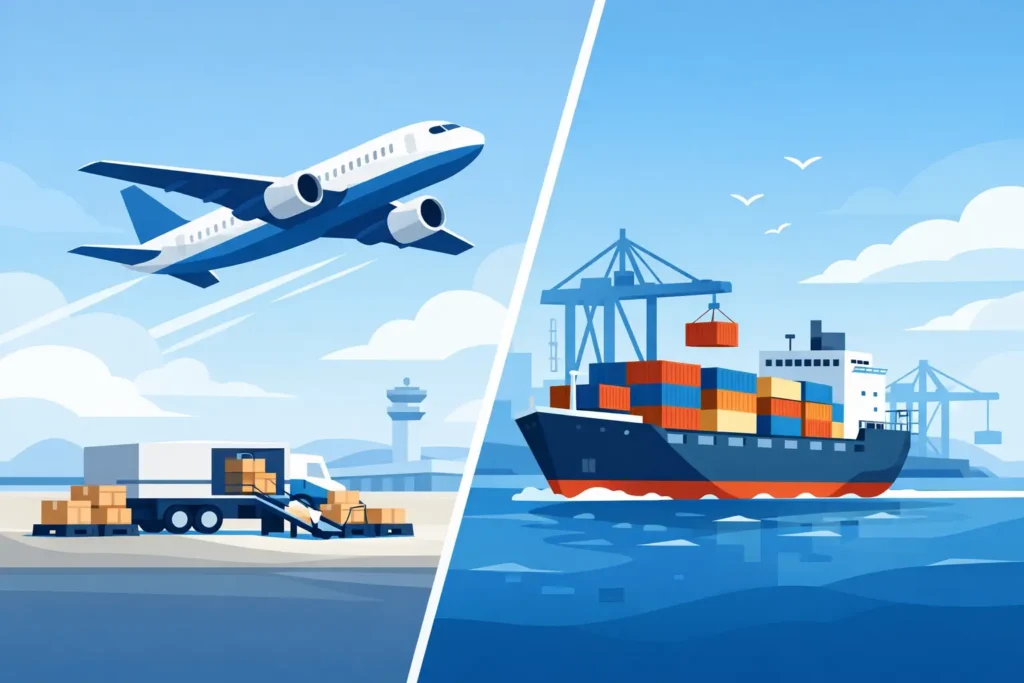
A delayed shipment can stall production, miss a retail launch, or leave inventory sitting at origin while costs keep rising. That is why the air freight vs sea freight decision is rarely just about transit time. For importers, exporters, and supply chain teams moving cargo to and from the UAE, India, and other global markets, the right choice depends on what you are shipping, how fast you need it, and what level of cost pressure your business can absorb.
Some shipments clearly belong in the air. Others should almost always move by sea. Many fall somewhere in between, where the better option depends on margins, product type, order frequency, customs timing, and how much disruption your supply chain can handle.
Air freight vs sea freight: the core difference
Air freight is built for speed, tighter scheduling, and high-value cargo. Sea freight is designed for volume, lower per-unit transport cost, and cargo that can work within longer lead times. That basic distinction is familiar, but the real business impact comes from how each mode affects inventory planning, landed cost, damage exposure, and customer commitments.
Air shipments usually move in days rather than weeks. That makes them useful for urgent replenishment, spare parts, electronics, medical cargo, fashion goods with narrow sales windows, and products where delay costs more than transport. The trade-off is straightforward: air freight is significantly more expensive, especially for heavy or bulky cargo.
Sea freight gives importers and exporters much better economics when cargo volume is high or shipment cycles are predictable. Full container load and less-than-container load options also allow businesses to scale depending on order size. The trade-off is longer transit, more port handling stages, and greater exposure to schedule shifts caused by congestion, weather, and vessel rollovers.
When air freight is the better choice
If your shipment is time-sensitive, air freight often protects more than delivery speed. It protects sales, production continuity, and service reliability.
A manufacturer waiting on a critical component may lose far more from downtime than from paying a premium for air transport. A distributor with an urgent restock need may choose air to avoid stockouts across multiple markets. Businesses launching products or fulfilling seasonal demand also tend to favor air when timing is tied directly to revenue.
Air freight also makes sense for cargo with a high value-to-weight ratio. If the goods are expensive but relatively lightweight, transport cost may represent a manageable percentage of the final selling price. This is common with electronics, luxury items, certain automotive parts, pharmaceuticals, and specialized commercial equipment.
There is another operational benefit that matters to supply chain managers: shorter transit can reduce inventory carrying costs. You may spend more on freight, but hold less stock in transit and respond faster to demand changes. For businesses that prioritize agility over bulk savings, that can be the smarter financial result.
When sea freight is the better choice
Sea freight is usually the stronger option when cost control and cargo volume matter more than speed. For many importers and exporters, that covers the majority of regular trade.
If you are moving machinery, raw materials, furniture, consumer goods, vehicle shipments, or palletized cargo in larger quantities, sea freight offers much better cost efficiency. Heavy and oversized cargo that would be prohibitively expensive by air is often well suited to ocean transport, including break bulk, RORO, and project cargo depending on the shipment profile.
Sea freight is also more flexible for businesses with stable forecasting. If your procurement team can plan around production cycles and order windows, longer transit becomes manageable. In those cases, lower freight spend improves margins without creating service risk.
For shipments between major trade hubs in India, the UAE, and international markets, sea freight often becomes the default mode for recurring commercial cargo because it supports both scale and cost discipline. The key is planning early enough to absorb transit time and potential port-related delays.
Cost is not just freight rate
The biggest mistake in the air freight vs sea freight comparison is treating the quoted freight charge as the whole decision. It is only one part of landed cost.
Air freight has a higher transport rate, but it can reduce warehousing needs, lower safety stock requirements, and help avoid losses tied to urgent shortages. Sea freight has a lower transport cost, but longer lead times may require more inventory on hand, more working capital tied up in stock, and more buffer time in the schedule.
There are also handling and accessorial considerations. Sea freight can involve port charges, container detention or demurrage exposure, deconsolidation fees in LCL movements, and more handoff points. Air freight may involve dimensional weight pricing, airline capacity fluctuations, and strict packaging or commodity restrictions.
So the right question is not, which mode is cheaper? It is, which mode creates the better total commercial outcome for this shipment?
Transit time and reliability
Air freight is faster, but speed and reliability are not identical. In most cases, air offers better schedule control than sea, especially for urgent cargo. Yet airline capacity constraints, peak season pressure, and customs documentation issues can still create delays.
Sea freight has longer and more variable transit. A shipment may sail on time one week and face port congestion the next. Transshipment cargo can add another layer of unpredictability. That does not make sea freight unreliable by default, but it does mean businesses need stronger planning discipline.
For companies moving cargo to or from India and the UAE, customs readiness matters as much as mode choice. A fast-moving shipment loses its advantage if documents are incomplete or clearance is delayed. This is where freight forwarding support with customs handling experience becomes especially valuable.
Cargo type changes the answer
Not every product can move efficiently by either mode. Shipment characteristics often decide the route before cost discussions even begin.
Perishable goods, urgent medical items, high-value electronics, and spare parts usually lean toward air because delay affects usability or business continuity. Large commercial shipments, industrial equipment, non-urgent retail inventory, and vehicle transport usually lean toward sea because volume and weight make ocean freight more practical.
Fragility also matters. Air freight often reduces total handling time and shortens exposure during transit, which can benefit delicate or sensitive cargo. Sea freight, however, may still be the right option if packing, container securing, and cargo lashing are handled properly. The right packaging standard should match the transport mode, route conditions, and cargo risk.
Hazardous goods, oversized cargo, and specialized equipment may require mode-specific approvals, routing reviews, and compliance checks. In those cases, the best option is the one that can be executed safely and legally without avoidable delay.
Air freight vs sea freight for common business scenarios
If you are replenishing inventory after an unexpected sales spike, air freight is often the better short-term fix. If you are planning a regular monthly import program, sea freight usually supports better margins.
If your cargo is lightweight, expensive, and needed quickly, air is likely justified. If your cargo is bulky, heavy, and not time-critical, sea is usually the logical choice.
If you are shipping a sample, urgent replacement part, or launch-critical SKU, air offers speed and control. If you are moving full loads, project cargo, vehicles, or consolidated commercial shipments, sea provides stronger economics and capacity.
Many businesses should not treat this as an either-or decision. A blended strategy often works better. Core inventory can move by sea, while urgent top-up shipments move by air when needed. That approach balances cost with service continuity and reduces the risk of overcommitting to one mode.
How to choose the right mode for your shipment
Start with the commercial deadline. Ask what happens if the cargo arrives late. If the answer involves lost revenue, idle labor, contract penalties, or customer disruption, air freight deserves serious consideration.
Then look at cargo density, shipment volume, and product value. Heavy, low-margin goods rarely belong on an aircraft unless there is a genuine emergency. Lightweight, high-value products often justify the premium more easily.
Next, evaluate your inventory model. Businesses with lean stock positions or volatile demand may benefit from air despite the cost. Businesses with stable procurement schedules can usually gain more from sea freight savings.
Finally, review the route itself. Port congestion, airline space availability, customs requirements, final delivery timelines, and special cargo handling needs all affect the best choice. A capable freight partner should help assess the full move, not just quote a rate.
For businesses shipping across India, the UAE, and international trade lanes, the best freight decisions come from matching mode to business priority, not forcing every shipment into the same template. When timing, cargo profile, and cost are aligned, the shipment works the way it should – fast where it must be, economical where it can be, and reliable all the way through.
