
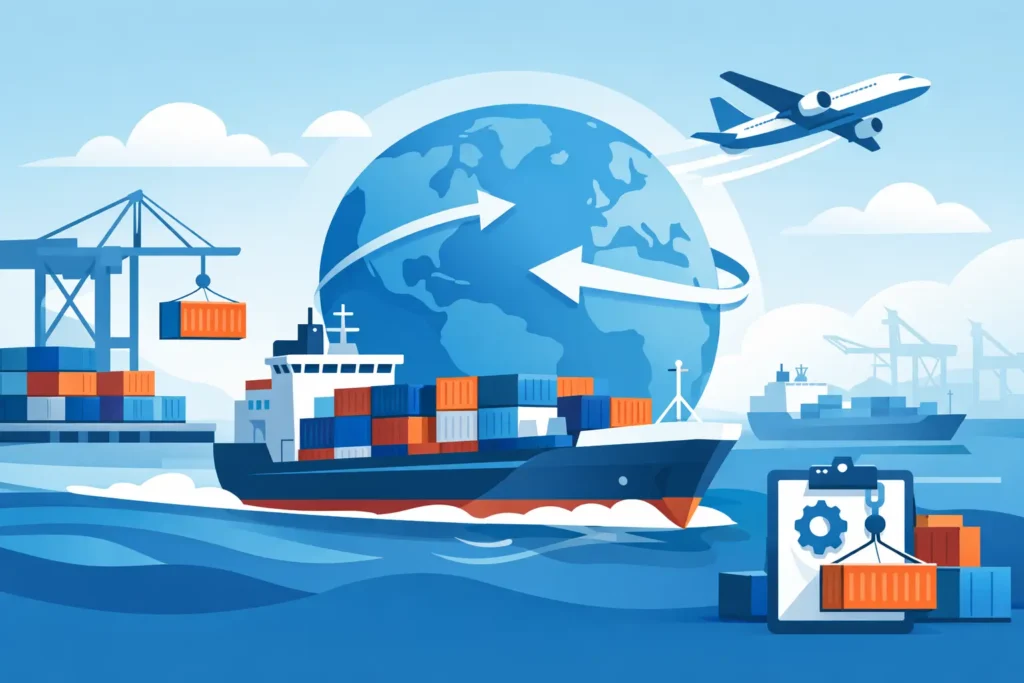
A shipment that looks cost-effective on paper can become expensive fast if the mode, container type, or routing does not match the cargo. That is why ocean freight remains a strategic decision, not just a booking choice. For importers, exporters, and supply chain teams moving goods to and from India, the UAE, and other global markets, the right ocean plan can improve landed cost, protect cargo, and reduce delays at origin and destination.
Why ocean freight still matters
Ocean freight continues to be the backbone of global trade because it moves large volumes at a lower cost per unit than air. That matters when businesses are shipping heavy cargo, palletized goods, machinery, raw materials, automotive cargo, or recurring commercial orders that need predictable transport economics.
The advantage is not just price. Ocean shipping gives businesses more flexibility in how they move cargo. A full container load can provide better security and schedule control for stable volumes, while less than container load service helps companies ship smaller quantities without waiting to fill an entire container. For many businesses, that flexibility is what keeps inventory moving without tying up unnecessary cash.
Still, lower freight cost does not automatically mean lower total cost. Transit times are longer, port congestion can disrupt schedules, and customs documentation has to be accurate from the start. Ocean freight works best when it is planned as part of the full supply chain, including pickup, packing, customs clearance, warehousing, and final delivery.
Choosing the right ocean freight option
The best shipping setup depends on cargo type, budget, timing, and destination requirements. There is no single model that suits every shipment.
FCL for volume, security, and consistency
Full container load, or FCL, is often the strongest option when a shipper has enough cargo to justify a dedicated container or when cargo security is a priority. Because the container is assigned to one shipper, handling points are reduced, which can lower the risk of damage and simplify cargo control.
FCL often makes sense for manufacturers, distributors, and importers with regular replenishment cycles. It can also work well for high-value cargo, project cargo components, or goods that need controlled loading patterns. The trade-off is straightforward – if volume is low, paying for a full container may not be the most efficient use of budget.
LCL for smaller shipments
Less than container load, or LCL, allows multiple shippers to share container space. This is useful for businesses that want to move goods without waiting to build container volume. For SMEs and seasonal importers, LCL can support cash flow by allowing more frequent shipments in smaller quantities.
The trade-off is that LCL usually involves more cargo handling, consolidation, and deconsolidation. That can add time and may increase the importance of strong packing and labeling. When cargo is fragile, urgent, or highly sensitive to handling, the savings from LCL should be weighed against those operational realities.
Specialized ocean freight services
Some shipments do not fit standard container movement. Break bulk, RORO, and project cargo solutions are often needed for oversized equipment, vehicles, industrial components, and out-of-gauge cargo. These moves require closer planning because loading methods, vessel options, port capabilities, and inland transport all affect execution.
This is where operational experience matters. Specialized cargo is less forgiving than general freight. Route design, cargo securing, customs coordination, and timing at transshipment points all need to be aligned before the shipment leaves origin.
Cost in ocean freight is more than the freight rate
Many shippers focus first on the ocean rate, but the freight rate is only one part of the total spend. A realistic budget should include origin charges, destination charges, customs clearance, inland transport, storage risk, documentation fees, insurance, and any demurrage or detention exposure.
For example, a lower base rate may look attractive until port delays lead to storage charges or a weak routing decision creates inventory shortages. In some cases, paying slightly more for a better sailing schedule or stronger carrier option protects the business from much larger downstream costs.
This is especially relevant on trade lanes connected to India and the UAE, where shipment timing often intersects with customs processes, regional demand cycles, and port handling requirements. Cost control comes from end-to-end planning, not from selecting the cheapest line item.
Transit time, reliability, and planning windows
Ocean freight is slower than air, but that does not make it unpredictable by default. What matters is how well transit time is planned against procurement cycles, inventory levels, and delivery commitments.
A business shipping spare parts for urgent operations may find ocean service too slow unless stock buffers are already in place. On the other hand, a company moving monthly commercial cargo can often gain significant savings by shifting the right volume to sea freight and managing replenishment more carefully.
Reliability also depends on route design. Direct sailings may reduce transit risk, but they are not available on every lane. Transshipment options can expand coverage and improve pricing, though they may introduce another point where delays can occur. The right choice depends on the value of the cargo, the required delivery window, and how much schedule flexibility the shipment can tolerate.
Documentation and customs can make or break a shipment
A container can be packed correctly, booked on time, and still run into problems if documentation is incomplete or inconsistent. Commercial invoices, packing lists, bills of lading, certificates, HS code classifications, and permit-related documents all need to align with the cargo and the destination rules.
For businesses shipping into or out of India and the UAE, customs handling is a critical part of freight execution. A delay in clearance can erase the value of a well-priced booking. That is why many shippers prefer working with a logistics partner that can manage both freight and customs as one coordinated process.
Accuracy matters even more for regulated products, high-value goods, automotive shipments, and project cargo. In those cases, errors do not just cause delays. They can create compliance exposure, storage costs, and delivery failures that affect the customer relationship.
Protecting cargo during ocean freight movement
Longer transit times and multiple handling stages make cargo protection a practical priority. Good packing is the first step, but it is not the only one. Container suitability, cargo lashing, moisture control, load distribution, and marine insurance all play a role.
Different cargo types have different risks. Machinery may require reinforced securing. Consumer goods may need moisture protection. Vehicles and oversized units often need route-specific loading and securing plans. If cargo moves across inland and port environments before loading onto the vessel, those transitions should be considered as part of the protection strategy.
Insurance is also worth addressing early rather than as an afterthought. Marine insurance does not prevent disruption, but it can reduce the financial impact of damage, loss, or unforeseen transit events. For many businesses, that is a sensible part of risk management, especially on international lanes with multiple transfer points.
What businesses should expect from an ocean freight partner
A freight forwarder should do more than arrange vessel space. The real value comes from matching the right service to the cargo, advising on routing and documentation, managing customs requirements, and keeping shipments visible from origin to final delivery.
That matters even more when shipments involve India-UAE trade or wider international movement with inland coordination on both ends. A capable partner should be able to handle standard cargo, support LCL and FCL decisions, manage specialized freight where needed, and identify operational issues before they become expensive problems. At Mass Freight Forwarding, that end-to-end approach is central to how customers reduce friction across cross-border shipments.
The strongest logistics support is practical. It gives businesses clear options, realistic transit expectations, and a plan that fits both budget and cargo profile. That may mean choosing ocean freight for core volume, combining it with warehousing, or using a mixed-mode strategy when timing changes.
Ocean freight works best when it is treated as a business tool, not just a transport mode. When the service is aligned with cargo, customs, and delivery requirements, it gives companies room to control cost without losing sight of reliability – and that is where better shipping decisions start.
