
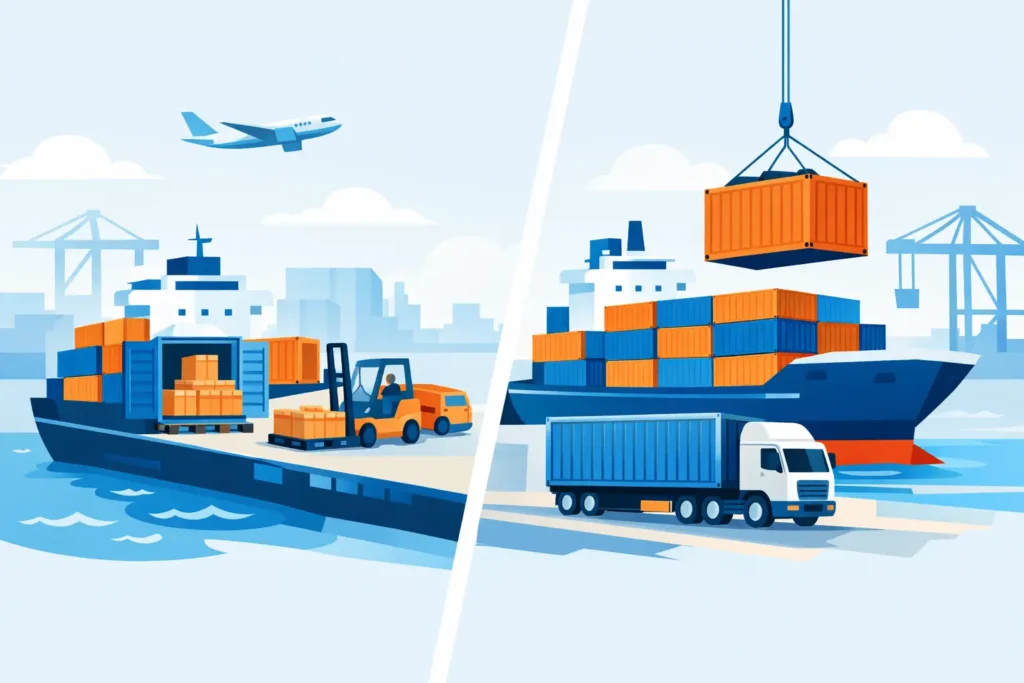
When a shipment is too large for courier but not simple enough to ignore container strategy, the lcl vs fcl shipping decision starts affecting cost, timing, and inventory planning right away. For importers and exporters moving cargo to or from India, the UAE, and other major trade lanes, this is not a minor booking detail. It shapes how efficiently goods move through consolidation, customs, deconsolidation, and final delivery.
Both options are widely used in ocean freight, and neither is automatically better. The right choice depends on shipment volume, cargo sensitivity, transit urgency, budget pressure, and how much flexibility your supply chain can handle.
What lcl vs fcl shipping actually means
LCL stands for Less than Container Load. Your cargo shares container space with freight from other shippers. This is a practical option when you do not have enough volume to fill an entire container but still want to move goods by sea at a competitive rate.
FCL stands for Full Container Load. In this model, you book the entire container for your cargo alone, whether you fully utilize the space or not. That gives you more control over loading, handling, and scheduling, which is often valuable for larger or more sensitive shipments.
At a basic level, lcl vs fcl shipping is a choice between shared capacity and dedicated capacity. The cost structure, handling process, and transit experience are different from the moment cargo is received at origin.
Cost differences in lcl vs fcl shipping
Cost is usually the first question, but it needs context. LCL often looks cheaper upfront because you only pay for the space your cargo uses. For small shipments, that can make strong financial sense. If you are shipping a few pallets, cartons, or a limited production batch, paying for a full container may not be efficient.
That said, LCL pricing includes more than basic ocean freight. Consolidation charges, destination handling, deconsolidation fees, documentation, and warehouse movement can add up. On paper, LCL may appear economical at origin, then become less attractive once all destination costs are included.
FCL usually carries a higher base cost because you are paying for the whole container. But as cargo volume increases, the cost per cubic meter or per unit often becomes lower than LCL. Once shipments reach a certain threshold, FCL becomes the more cost-effective choice.
This is where planning matters. A business shipping regular stock replenishment from India to the UAE, or from the UAE to other markets, may save more over time by consolidating purchase orders into fewer FCL shipments rather than sending multiple smaller LCL loads.
When LCL is usually more cost-effective
LCL tends to work best when shipment volumes are small, order frequency is irregular, or inventory strategy favors lower upfront freight spend. It also suits test shipments, sample-led expansion into new markets, and businesses that want to avoid paying for unused container space.
When FCL usually saves more
FCL starts making better financial sense when cargo volume is high enough to justify dedicated space, or when avoiding extra handling reduces loss, delay, and administrative costs. For many commercial shippers, total landed cost matters more than the cheapest line item on a quote.
Transit time and operational speed
If speed and predictability matter, FCL often has the advantage. Since the container is booked by one shipper, cargo can move through origin handling more directly. There is no need to wait for enough compatible freight to build a consolidated load, and destination unpacking is generally simpler.
LCL adds extra steps. Cargo must be received into a warehouse, sorted, consolidated with other shipments, loaded into a shared container, and then separated again at destination. Each handoff creates another point where timing can stretch.
That does not mean LCL is unreliable. It simply means there are more process stages involved. For businesses working with fixed launch dates, factory shutdown schedules, or time-sensitive stock allocation, those extra stages should be considered before booking.
In busy corridors such as India-UAE shipping, port congestion, customs review, and local delivery coordination can affect both modes. But FCL generally gives better schedule control when timelines are tight.
Cargo safety and handling risk
Handling exposure is one of the clearest differences between these two options. In LCL, your cargo is handled alongside other shipments. It is moved into consolidation facilities, loaded with freight from multiple parties, and unpacked again at destination. That means more touchpoints.
For standard, durable cargo, this may be perfectly manageable with proper packing and professional handling. But for fragile goods, high-value items, branded retail stock, sensitive machinery, or cargo with strict packaging requirements, FCL offers a stronger layer of control.
With FCL, cargo is loaded into one container and stays there until arrival, apart from inspection if required. Fewer handling events usually mean lower risk of damage, contamination, mislabeling, or cargo mix-up.
This becomes especially relevant for shippers moving automotive parts, electronics, specialty materials, or products where packaging integrity directly affects resale value. In those cases, the savings from LCL can disappear quickly if the cargo arrives compromised.
Volume, frequency, and inventory strategy
The lcl vs fcl shipping choice is often tied to a broader supply chain model rather than one isolated shipment. A business with lean inventory practices may prefer smaller, more frequent LCL movements to keep storage costs under control. That can work well when demand is variable and purchase cycles are short.
On the other hand, companies with stable demand and predictable procurement schedules may benefit from FCL. Larger, planned shipments often create better freight economics and fewer operational interruptions. If your team is repeatedly shipping similar cargo on the same route, FCL may improve consistency.
There is also a middle ground. Some shippers start with LCL while entering a market, then shift to FCL as order volume grows. Others use both, booking FCL for core product lines and LCL for urgent top-ups or lower-volume SKUs.
That mixed approach is common and often smart. Shipping decisions do not need to be rigid if the freight plan is aligned with sales cycles, warehouse capacity, and customer delivery expectations.
Customs and destination coordination
Customs clearance can be smooth in either mode when documentation is correct, but LCL shipments may involve more coordination at destination because multiple consignees and cargo lots are involved in the same container environment. Timing at the deconsolidation stage can affect availability for final delivery.
FCL can simplify destination movement because the shipment remains under one booking and one container structure. For businesses that need more direct control from port to warehouse, this can reduce friction.
This is one reason many importers working through India and the UAE prefer to partner with a freight forwarder that handles both transport and customs execution. Operational visibility matters more when cargo moves across multiple jurisdictions, port systems, and final-mile arrangements.
How to decide between LCL and FCL
A practical decision starts with four questions. How much cargo are you shipping now? How often will you ship it? How sensitive is the cargo to handling? And what costs matter most – upfront freight spend or total landed cost?
If your shipment is small, budget-sensitive, and flexible on timing, LCL may be the right fit. If your cargo volume is large, your goods need more protection, or your replenishment schedule leaves little room for delay, FCL is usually the stronger option.
It is also worth checking the break-even point instead of assuming. Many shippers continue using LCL simply because they started that way. But once volume grows, the numbers can shift in favor of FCL faster than expected.
At Mass Freight Forwarding, this is where route knowledge and shipment planning make a difference. The best answer is not based on theory. It comes from the cargo profile, trade lane, documentation flow, and final delivery requirement.
The smarter choice depends on the shipment
The real value in choosing between LCL and FCL is not finding a universal winner. It is matching the shipping mode to the commercial objective behind the cargo. A small shipment that arrives on budget and on plan is a success. A full container that protects margins, reduces handling, and keeps inventory stable is also a success.
The better question is not which option is better overall. It is which option gives your business more control, fewer surprises, and a better outcome on this specific move.
