
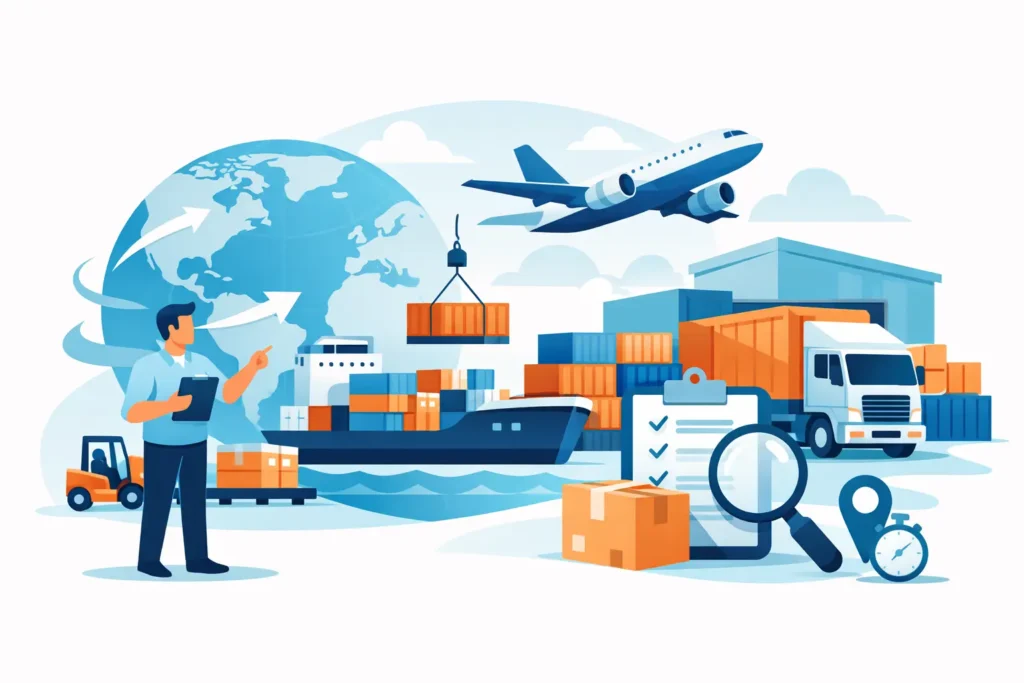
A delayed shipment rarely starts with the vessel or aircraft. More often, it starts with a missing document, a poor routing choice, cargo packed for the wrong handling conditions, or a customs requirement that was underestimated. That is why freight forwarding for exporters is not just about booking transport. It is about managing risk before cargo moves and keeping every stage aligned with your delivery commitment.
For exporters shipping from India, the UAE, or across connected trade lanes, the right forwarding setup can protect margins, reduce avoidable delays, and give your customers a more reliable delivery experience. The wrong setup usually costs more than the quoted freight rate suggests.
What freight forwarding for exporters actually covers
Exporters sometimes think of a freight forwarder as the party that arranges sea freight or air freight. That is part of the job, but only part. In practice, a forwarder coordinates the movement of cargo from origin to destination while managing documentation, carrier planning, customs support, cargo handling, and communication across multiple parties.
That matters because international shipping is rarely a single transaction. It includes pickup, export packing standards, warehouse handling, booking with carriers, customs filing, loading, transit milestones, destination coordination, and in many cases final delivery. If one link is weak, the shipment can stall or incur extra cost.
For exporters, this coordination becomes even more valuable when cargo has special requirements. That may include time-sensitive air cargo, LCL shipments that need consolidation, oversized project cargo, vehicles, break bulk, or shipments that need marine insurance and cargo lashing. A capable forwarder builds the solution around the cargo rather than forcing the cargo into a standard process.
Why exporters need more than a freight rate
A low rate can look attractive when procurement is under pressure, but freight cost is only one part of export performance. Transit predictability, customs accuracy, handling quality, and local execution at both ends often matter more than a small saving on the headline quote.
If your customer expects a factory input to arrive on schedule, a delayed container may stop production. If your cargo is high value, poor handling can create insurance issues and customer disputes. If documents are not aligned with product details, customs can hold the shipment even when the freight booking was cheap.
This is where experienced freight forwarding for exporters earns its value. It reduces friction across the full shipment cycle. A forwarder should help you choose the right mode, prepare the right paperwork, plan around route risk, and avoid preventable charges such as storage, demurrage, or amendment fees.
Choosing the right mode for the shipment
There is no single best shipping method for every exporter. It depends on cargo type, delivery deadline, budget, destination, and how much flexibility your customer allows.
Air freight when speed protects the sale
Air freight makes sense when time is more expensive than transport cost. That often applies to urgent replenishment orders, product launches, high-value goods, or components needed to keep production lines moving. The trade-off is straightforward. You gain speed and tighter transit windows, but the landed logistics cost is higher.
For exporters, air freight also requires disciplined documentation and packaging. Because timelines are shorter, there is less room to fix errors after cargo is handed over.
Ocean freight when volume and cost matter most
Ocean freight remains the standard choice for larger export volumes and cost-controlled planning. Full container load works well when cargo volume can support dedicated container use, while LCL can be practical for smaller shipments that do not need a full box.
The trade-off with ocean freight is time and variability. Sailing schedules, transshipment risk, port congestion, and customs timing all affect delivery. Exporters using ocean freight need stronger forecasting and better buffer planning than those shipping by air.
Land freight as part of a wider export chain
For many exporters, land freight is not the final mode but a critical connection between factory, port, airport, free zone, or customer facility. Poor inland coordination can disrupt an otherwise well-planned export movement. Pickup timing, cargo securing, local permits, and cross-border handling all need attention.
Freight forwarding for exporters in India and the UAE
India and the UAE are active trade hubs, but that does not mean shipments move on autopilot. Each market has its own documentation practices, customs expectations, port and airport procedures, and commercial realities. Exporters moving cargo between these regions or using them as gateways need a forwarding partner with operational presence and practical local knowledge.
That local capability makes a difference when shipments need customs clearance support, re-export handling, door-to-door coordination, warehousing, or tailored routing. It also matters when cargo is specialized. Vehicles, machinery, oversized cargo, and mixed commercial shipments often require more than standard booking support.
For companies trading regularly between India, the UAE, and wider global markets, execution quality at origin and destination is what keeps supply chains stable. A forwarder that understands both sides of the lane can reduce handoff issues, improve communication, and solve problems faster.
Documentation and customs are where many exports go wrong
Most costly export delays are preventable. They happen when documents do not match the cargo, product classification is mishandled, consignee details are incomplete, or market-specific compliance rules are treated as an afterthought.
A dependable forwarder should review shipping documents early, not after cargo is already booked. Commercial invoices, packing lists, certificates, permits, and shipping instructions must align with what customs authorities and carriers expect. That sounds basic, but it is one of the biggest differences between a smooth export and a shipment that sits waiting for corrections.
Customs support is especially important when exporters are entering new markets or shipping products with tighter compliance rules. In those cases, practical guidance is more useful than generic advice. The goal is to file correctly the first time and keep cargo moving.
What to look for in a freight forwarder
Exporters do not need the biggest provider. They need the right operational fit. That usually means a forwarder with route knowledge, responsive communication, and the ability to tailor service to the cargo instead of selling the same process to every shipper.
Look closely at how the forwarder handles exceptions. Anyone can quote a standard shipment. The real test is what happens when a sailing changes, customs asks for clarification, cargo needs repacking, or the consignee requests delivery adjustments. Reliable execution comes from control, not just promises.
It also helps to work with a forwarder that can support more than one part of the chain. If your provider can manage freight booking, customs clearance, warehousing, insurance, and final delivery coordination, you reduce the number of separate parties involved. That often means fewer communication gaps and faster issue resolution.
Mass Freight Forwarding supports exporters with this kind of end-to-end approach across India, the UAE, and global trade lanes, especially where cargo needs practical coordination rather than a basic booking service.
Common mistakes exporters can avoid
One common mistake is choosing mode and routing based only on rate. Another is treating packing as a warehouse task instead of a shipping decision. Cargo that is poorly packed, incorrectly labeled, or not secured for the mode of transport can create damage claims and delays that erase any initial savings.
Another issue is last-minute documentation. Exporters sometimes finalize paperwork too late, assuming corrections can be made while cargo is moving. Sometimes they can. Often they cannot, or the fix comes with delay and added cost.
There is also the problem of underestimating destination requirements. An export shipment is only successful when it reaches the buyer without avoidable disruption. Origin planning has to account for destination realities from the start.
A better way to think about export logistics
The strongest exporters treat freight as part of customer delivery, not as a back-office task. That shift changes decision-making. Instead of asking only what the freight costs, they ask what the shipment needs in order to arrive safely, clear correctly, and meet the promised timeline.
That is the real value of freight forwarding for exporters. It brings planning, transport, customs, and execution into one controlled process. When done well, it gives exporters more than movement. It gives them a shipping operation that supports growth, protects relationships, and keeps trade moving with fewer surprises.
If your export program is expanding, product mix is changing, or shipping between India, the UAE, and global markets is becoming more complex, it helps to work with a forwarding partner that can adjust with you rather than ask you to work around their limits.
