
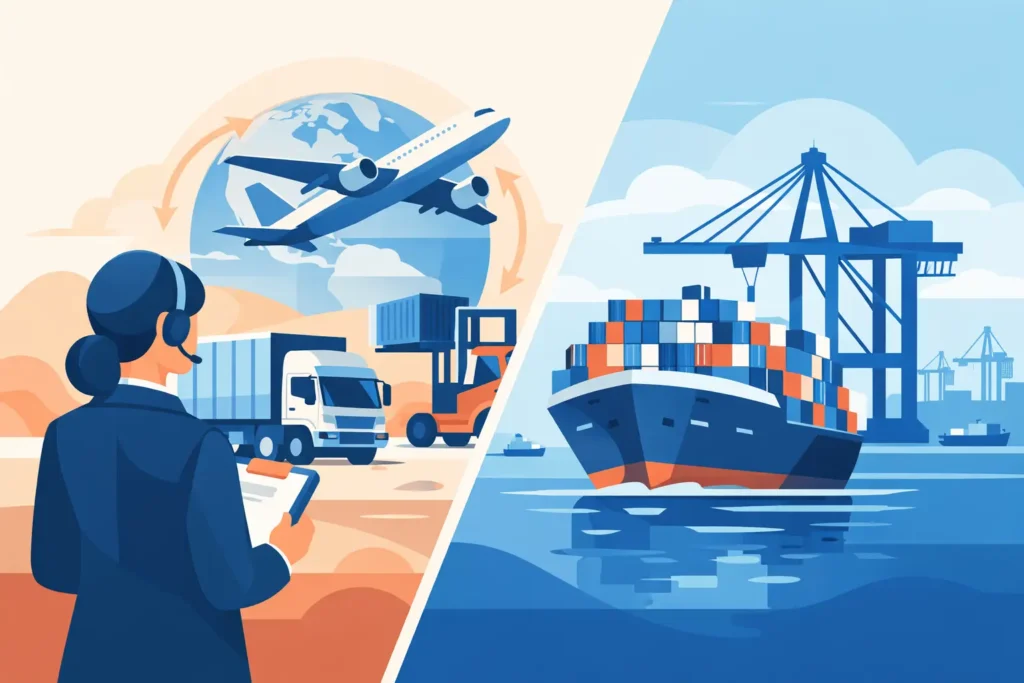
If a shipment is delayed at origin, rolled to a later vessel, or held up because documents were not filed correctly, the question usually comes fast: should you have booked with a shipping line directly or worked through a forwarder? That is where the freight forwarder vs shipping line decision becomes more than a terminology issue. It affects cost control, visibility, flexibility, and how much operational burden stays with your team.
For importers, exporters, and supply chain managers moving cargo to or from India, the UAE, and other global markets, the right choice depends on what you are shipping, how often you ship, and how much coordination you want one partner to handle. A shipping line and a freight forwarder both play critical roles in ocean logistics, but they do not do the same job.
Freight forwarder vs shipping line: the core difference
A shipping line is the carrier that operates the vessel and moves containers by sea. It owns or controls vessel space and is responsible for the ocean transport itself. If your cargo is moving in a container from Jebel Ali to Nhava Sheva or from Chennai to Dubai, the shipping line is the company physically carrying that container across the water.
A freight forwarder is a logistics service provider that arranges the shipment on your behalf. The forwarder may book space with a shipping line, but it can also manage pickup, consolidation, export documentation, customs clearance, insurance, warehousing, and final delivery. In simple terms, the shipping line moves the cargo on the vessel. The freight forwarder manages the shipment journey around that vessel movement.
This distinction matters because ocean freight is only one part of the full logistics chain. Most businesses do not just need port-to-port transport. They need cargo collected from a factory, prepared for export, documented correctly, cleared through customs, delivered on time, and tracked with fewer surprises.
What a shipping line actually handles
Shipping lines are focused on maritime transport. Their primary responsibility is to carry cargo between ports according to their vessel schedules and service routes. If you book directly with a line, you are buying ocean space from the carrier.
That can work well if your internal logistics team is experienced and you already have separate providers for trucking, customs, and destination handling. Large-volume shippers sometimes prefer direct carrier relationships because they have the scale to negotiate rates and manage the rest of the chain themselves.
But a direct booking with a shipping line usually does not mean end-to-end support. You may still need to coordinate with customs brokers, transporters, warehouse operators, and local agents. If something changes, such as a missed cutoff, a transshipment delay, or a documentation issue, your team often has to connect the pieces.
What a freight forwarder actually handles
A freight forwarder acts as the organizer of the shipment. That role becomes especially valuable when cargo is moving across multiple parties, countries, and compliance requirements.
A forwarder can compare carrier options, select suitable sailings, secure space, and coordinate related services under one plan. This is often the better fit for companies that want fewer handoffs and clearer accountability. Instead of booking ocean freight and then separately arranging inland transport, customs, storage, and cargo protection, the shipper can work through one logistics partner.
For trade lanes involving India and the UAE, this matters even more. Customs procedures, port handling requirements, free zone movements, and timing between origin and destination operations can create avoidable delays when no one is managing the full picture. An experienced forwarder helps reduce that friction.
When booking directly with a shipping line makes sense
There are cases where a shipping line is the right choice. If your company ships high container volumes on fixed routes, has a strong in-house logistics department, and prefers to control every supporting vendor, direct carrier booking can offer advantages.
You may gain better visibility into base ocean rates, direct access to carrier schedules, and stronger leverage during contract negotiations if your annual volume is significant. This route can also suit businesses moving standard full container loads without unusual handling needs.
The trade-off is that lower headline freight rates do not always translate into lower total shipping cost. Port charges, local handling, customs coordination, storage risk, and delivery planning still need to be managed. If internal teams are stretched, the operational cost can rise even when the carrier rate looks attractive.
When a freight forwarder is the better choice
A freight forwarder is often the smarter option for small to mid-sized importers, exporters with mixed cargo profiles, and businesses that need flexible routing or support beyond port-to-port movement.
This is especially true when shipments involve LCL cargo, multiple suppliers, door-to-door delivery, project cargo, vehicle shipping, break bulk, or destination customs complexity. In these cases, execution matters as much as the ocean booking itself.
Forwarders also help when schedules shift. If one line has no space, if transit time needs to improve, or if the cargo requires a different service combination, a forwarder can usually adapt faster because it works across carriers and service providers rather than inside one carrier system.
That flexibility is valuable in volatile markets. Rates move, vessel schedules change, and port congestion can disrupt plans with little notice. A dependable forwarder helps protect continuity, not just the booking.
Cost comparison: cheaper is not always simpler
Many shippers approach the freight forwarder vs shipping line question by asking who is cheaper. The honest answer is: it depends on what costs you are measuring.
A shipping line may offer a competitive ocean freight rate, particularly for direct, high-volume bookings. But that rate covers only part of the journey. Once you add origin handling, export clearance, destination charges, customs brokerage, inland delivery, insurance, and potential exception management, the full landed cost can look very different.
A freight forwarder may quote a broader package that appears higher at first glance but includes services your team would otherwise source separately. That can make budgeting easier and reduce the chance of hidden coordination costs later.
The better comparison is not line rate versus forwarder rate. It is total cost, total effort, and total risk.
Service scope matters more than labels
The biggest mistake shippers make is choosing based on label rather than need. A shipping line is not a substitute for a logistics partner if your shipment requires planning across several functions. Likewise, a freight forwarder is not automatically the best choice if your business already manages customs, warehousing, and inland transport efficiently on its own.
Ask what the shipment actually needs. Is it a simple port-to-port FCL move, or does it involve pickups from multiple suppliers? Does it need customs clearance in India or the UAE? Is the cargo high value, oversized, time-sensitive, or subject to special documentation? Those details usually make the decision clearer.
Freight forwarder vs shipping line for India and UAE trade
On India-UAE corridors, experience on both sides of the shipment can make a measurable difference. Documentation accuracy, port familiarity, customs timing, and local coordination all affect whether cargo moves smoothly or gets stuck between departments and deadlines.
That is why many businesses prefer working with a forwarder that can support both origin and destination operations. Instead of treating ocean freight as an isolated transaction, they need a provider that understands the full trade lane. Mass Freight Forwarding supports this model by coordinating cargo movement, clearance, and related logistics across India, the UAE, and international routes.
For businesses shipping regularly between these markets, that kind of integrated handling can reduce delays, improve communication, and give procurement and logistics teams one clear point of contact.
How to decide which one fits your shipment
Start with your internal capability. If your company has strong logistics resources and only needs vessel space, a shipping line may be enough. If your team wants support with planning, documentation, customs, routing, or last-mile coordination, a freight forwarder is usually the more practical choice.
Then look at cargo complexity. Standard containerized cargo on stable schedules is easier to manage directly. Specialized cargo, LCL shipments, urgent freight, automotive transport, project cargo, and door-to-door moves usually benefit from forwarder oversight.
Finally, think beyond the booking. The best logistics decision is not the one that looks simplest on a freight sheet. It is the one that keeps cargo moving with fewer delays, fewer handoffs, and fewer avoidable costs.
The right partner depends on how much of the journey you want to manage yourself. If your shipment needs more than ocean transport, choose the option built to handle more than ocean transport.
