
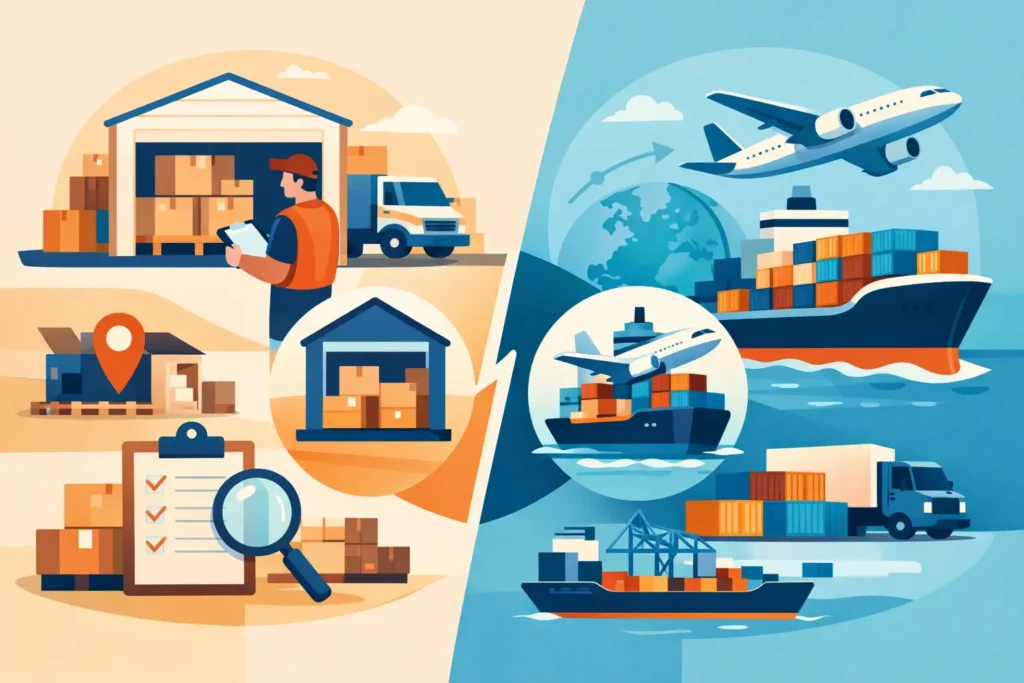
A shipment is ready to move from India to the UAE, or from the UAE into a wider global market, and the first question is often not about price. It is about responsibility. When comparing 3PL vs freight forwarding, businesses are really asking who should handle transportation, who should manage storage, and who should take control when customs, timelines, and delivery demands start to overlap.
That distinction matters because these two services are related, but they are not interchangeable. Choosing the wrong model can create extra handoffs, slower response times, and costs that were never visible in the first quote. Choosing the right one can simplify the movement of cargo and give your team better control over lead times, inventory, and customer commitments.
3PL vs freight forwarding: the core difference
Freight forwarding is centered on moving cargo from one place to another. A freight forwarder arranges transportation across air, ocean, and land networks, coordinates documentation, works with carriers, and often supports customs clearance. The focus is shipment execution.
A 3PL, or third-party logistics provider, usually operates at a broader level. In addition to transportation, a 3PL may handle warehousing, inventory management, order fulfillment, distribution planning, packaging coordination, and returns. The focus is supply chain management, not just shipment booking.
In simple terms, a freight forwarder helps move freight. A 3PL helps run part of your logistics operation.
That said, the line is not always rigid. Some freight forwarders also offer warehousing and distribution support. Some 3PLs manage international freight movements through their own forwarding capabilities or partner networks. This is why businesses should evaluate the service scope, not just the label.
What a freight forwarder actually does
A freight forwarder is often the right fit when cargo needs to cross borders efficiently and compliantly. This is especially true for importers and exporters shipping into or out of India and the UAE, where customs procedures, transit options, and port or airport coordination can affect delivery schedules.
The forwarder’s role typically includes selecting the best route, booking cargo space, preparing or checking shipping documents, coordinating pickup and delivery, and managing communication between carriers, customs agents, and the customer. For specialized cargo, the role may also extend to project handling, marine insurance coordination, break bulk planning, RORO moves, or lashing and securing requirements.
This model works well when your main challenge is transportation complexity. If you do not need daily inventory handling or fulfillment support, freight forwarding may be the more efficient choice.
A manufacturer exporting machinery, for example, may only need pickup, export documentation, ocean freight, destination customs clearance, and delivery to site. In that case, a strong freight forwarder can manage the movement without adding unnecessary warehousing services.
What a 3PL actually does
A 3PL usually becomes more valuable when the shipment is only one part of a larger logistics need. If your business carries stock, fulfills recurring orders, serves multiple markets, or needs distribution support after goods arrive, a 3PL can take over functions that would otherwise require internal resources.
That can include receiving inbound cargo, storing it in a warehouse, tracking inventory levels, processing outbound orders, arranging last-mile delivery, and coordinating replenishment. Some 3PL providers also support labeling, packing, kitting, and reverse logistics.
For a growing business, this can reduce operational pressure. Instead of managing transport with one vendor, warehousing with another, and local distribution with a third, the company works through a single logistics framework.
The trade-off is that 3PL services are usually broader and more integrated, which means the provider must understand not only freight movement but also your order patterns, SKU behavior, service levels, and operational priorities. If your needs are simple and shipment-based, a full 3PL setup may be more than you require.
When freight forwarding is the better choice
Freight forwarding is often the better fit when shipments are international, less frequent, project-based, or heavily dependent on routing and customs expertise. It is also a practical option for businesses that already manage their own warehousing or do not need storage at all.
For example, if you import raw materials into the UAE for direct use in production, you may not need a third-party warehouse network. You may need reliable port handling, customs clearance, and inland delivery on a fixed schedule. In that case, freight forwarding keeps the service focused and cost aligned with the task.
It also makes sense for businesses moving oversized cargo, vehicles, LCL shipments, or urgent air freight where carrier coordination and documentation accuracy are more important than inventory management.
When a 3PL is the better choice
A 3PL is often the stronger option when logistics affects customer service every day, not just when a shipment arrives. If you sell across multiple channels, distribute to retailers, or need stock positioned in more than one market, transportation alone will not solve the larger supply chain problem.
A good example is an importer bringing goods into India or the UAE and then distributing them across regional customers. Once the cargo lands, warehouse handling, stock control, and outbound order management become just as important as the inbound freight. A 3PL can help connect those activities into one operating model.
This can also improve forecasting and reduce carrying costs if the provider offers visibility into inventory movement and replenishment timing. The benefit is not only convenience. It is operational control.
Cost is not as straightforward as it looks
Many businesses assume freight forwarding is always cheaper than 3PL, but that depends on what your business is trying to accomplish.
Freight forwarding usually has a narrower cost structure because you are paying for transportation-related services. If that is all you need, it can absolutely be the more cost-effective model. But if your team still needs to arrange storage, monitor stock, coordinate deliveries, and solve exceptions after arrival, those internal costs should be part of the comparison.
On the other hand, a 3PL may look more expensive at first because it bundles more services. Yet it may reduce labor demands, warehouse overhead, split-vendor inefficiencies, and service failures. The right question is not which option has the lower quote. It is which option lowers your total logistics burden.
3PL vs freight forwarding for India and UAE trade lanes
For businesses moving cargo between India, the UAE, and global destinations, this choice often comes down to the level of support needed before and after transit.
If the shipment requires customs coordination, carrier selection, transshipment planning, or specialized handling, freight forwarding expertise is essential. These trade lanes can involve tight documentation standards, multimodal routing decisions, and timing sensitivity around port and airport operations.
If the same business also needs warehousing in the UAE, stockholding for regional distribution, or ongoing order fulfillment after import, a 3PL layer becomes valuable. That is why many importers and exporters need a logistics partner that can provide freight forwarding first, then extend into broader 3PL support when the operation demands it.
For companies scaling across these corridors, flexibility matters more than labels. A provider should be able to support single shipments, recurring cargo flows, and more integrated logistics requirements without forcing a one-size-fits-all model.
How to decide what fits your business
Start with the pressure point in your operation. If the main issue is getting cargo booked, shipped, cleared, and delivered across borders, focus on freight forwarding capability. If the main issue is what happens to the cargo before and after transportation, look closely at 3PL services.
Then assess shipment frequency, inventory exposure, number of delivery points, and how much control your internal team can realistically manage. A business with occasional international shipments has a very different requirement from one handling weekly imports and regional distribution.
It is also worth asking whether your provider can scale with you. Many companies begin with forwarding support and later need warehousing, distribution, or door-to-door coordination. Working with an experienced logistics partner such as Mass Freight Forwarding can make that transition easier because the service model can expand as your cargo profile and trade volume grow.
The best logistics setup is the one that matches your current operation without limiting your next move. If your supply chain depends on dependable transport, customs accuracy, and room to adapt, choose the model that gives you clarity before the cargo starts moving.
