
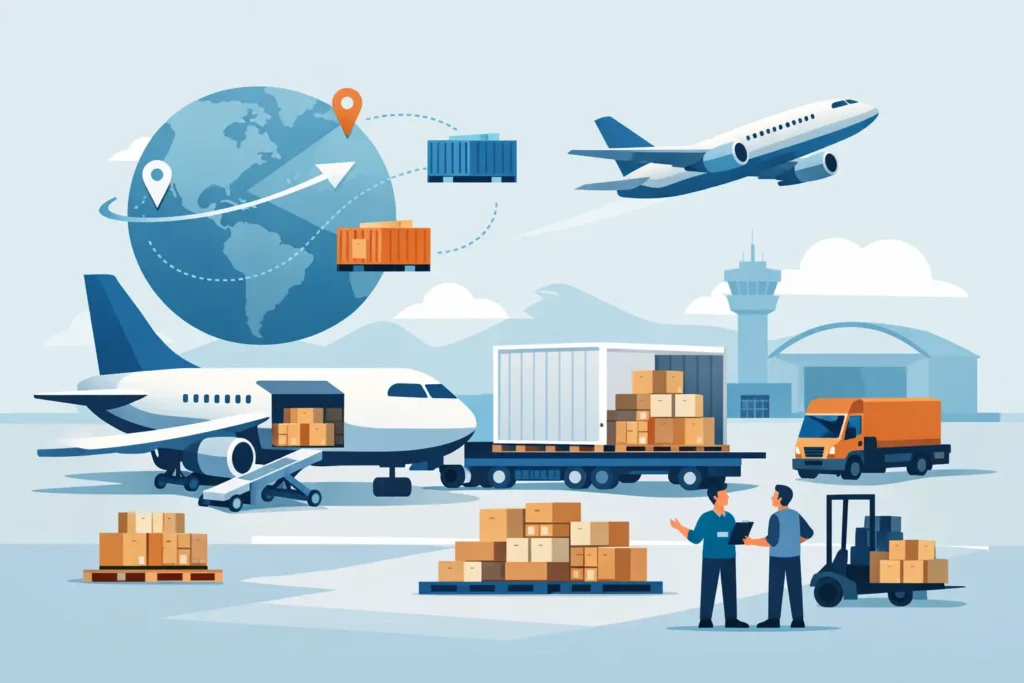
When a shipment is too urgent for ocean freight but too small to justify a dedicated air move, air freight consolidation services become the practical middle ground. For importers, exporters, and supply chain teams moving cargo to and from India, the UAE, and other global markets, consolidation can reduce cost without giving up the speed advantage that makes air freight valuable in the first place.
The concept is straightforward. Multiple shipments from different shippers are combined into one larger air shipment. That larger shipment moves under a consolidated booking, then gets separated at destination for final delivery or onward handling. What matters is not just the shared space on the aircraft, but the planning behind it – cutoff times, cargo compatibility, documentation accuracy, customs coordination, and delivery timing all have to line up.
What air freight consolidation services actually do
At an operational level, consolidation services group smaller consignments that are heading to the same airport, region, or trade lane. Instead of paying rates that often apply to lower-volume shipments, each shipper benefits from the economics of a larger combined load. This is especially useful for businesses that ship regularly but not in volumes large enough to fill airline unit load devices or secure the best direct rates on their own.
A good consolidator does more than combine boxes. The service usually includes cargo acceptance, screening, labeling, documentation checks, booking management, transit planning, customs support, deconsolidation at arrival, and coordination for final-mile delivery if needed. For many shippers, that operational control is where the real value sits. Lower freight spend matters, but avoiding delays caused by poor coordination matters just as much.
Why businesses use air freight consolidation services
The most obvious reason is cost control. Air freight is fast, but it is also one of the most expensive shipping modes on a per-kilogram basis. Consolidation gives smaller and mid-sized shippers access to better rate structures by spreading linehaul costs across multiple shipments.
That said, cost is rarely the only driver. Many businesses choose consolidation because it creates more consistent movement for routine cargo. If you are shipping replacement parts, retail replenishment stock, electronics, garments, or commercial samples on a regular schedule, a consolidation program can offer a more predictable rhythm than booking every shipment as a one-off.
There is also a planning advantage. Supply chain managers often need to balance urgency against margin. Not every shipment deserves express treatment, but some cargo cannot wait for sea freight. Consolidated air freight sits in that middle space. It gives companies a faster option than ocean freight while helping them avoid the premium attached to highly urgent, direct, or charter-based air solutions.
When consolidation is the right fit – and when it is not
Consolidation works best for cargo that is time-sensitive but not same-day critical. If your business can work with a defined consolidation schedule and accepts modest handling time at origin or destination, it can be a strong fit.
It is commonly used for general cargo, cartonized goods, spare parts, packaged commercial shipments, fashion products, and B2B inventory top-ups. Businesses shipping from manufacturing hubs in India to distributors in the UAE, or from UAE trading centers to regional buyers, often find this model useful because it supports recurring trade flows without forcing oversized freight budgets.
But consolidation is not right for every shipment. Highly urgent cargo, hazardous materials with special handling constraints, oversized freight, and highly sensitive products may require direct air freight instead. The same goes for shipments with very strict delivery windows where even a short consolidation hold could create a downstream problem.
This is where experience matters. A logistics partner should not push consolidation as the answer to everything. The right recommendation depends on commodity type, destination, customs requirements, delivery deadline, and the cost of delay if something goes off schedule.
How the process works from origin to destination
The shipment typically begins with cargo pickup or delivery to the consolidator’s receiving point. At this stage, dimensions, weight, packaging, and shipping documents are checked. If there are issues with labeling, invoice details, export declarations, or cargo readiness, those problems need to be fixed before the freight joins the consolidated load.
Once accepted, the cargo is grouped with other shipments moving on the same route. Space is booked with the airline, security procedures are completed, and the freight is prepared for export. The consolidated shipment moves under a master air waybill, while individual shippers are referenced under house documentation.
After arrival, the shipment is deconsolidated. Each consignee’s cargo is separated, cleared through customs as required, and released for collection or final delivery. If the service provider also handles customs clearance and inland transport, the handoff is simpler and the risk of communication gaps drops.
For shippers moving cargo through India and the UAE, this joined-up handling can make a meaningful difference. Documentation standards, customs timing, and local delivery coordination all affect total transit time, not just the flight itself.
The main benefits beyond lower freight rates
Cost savings get attention first, but the broader operational benefits often have more impact over time. Consolidation can improve shipment planning because departures are scheduled around known cutoffs. It can also support inventory control by creating regular movement windows rather than irregular emergency bookings.
Another benefit is access. Smaller businesses do not always have the shipping volume to negotiate favorable airline arrangements or to manage complex air export procedures internally. Consolidation gives them access to a more organized air freight channel without building that capability from scratch.
There is also less administrative friction when the provider manages documentation and customs interfaces as part of the service. Errors in commercial invoices, packing lists, or consignee details can slow down cargo regardless of transport mode. A provider that catches these issues before uplift helps protect both transit time and landed cost.
What affects the success of a consolidation program
Not all consolidation services perform the same way. Frequency is a major factor. A low-cost option loses value if departures are inconsistent or if cargo waits too long to build volume. The best setup depends on a balance between price and schedule reliability.
Trade lane experience matters as well. Shipping between India, the UAE, and international destinations requires practical knowledge of customs procedures, local handling practices, and routing alternatives. When a forwarder understands these corridors well, they can adjust faster if there are airline space issues, paperwork questions, or destination handling constraints.
Packaging is another overlooked factor. Consolidated cargo is handled alongside other shipments, so packaging needs to protect the goods through multiple touchpoints. Weak cartons, poor palletization, or unclear marking can create delays or damage that erase any savings achieved on freight.
Communication also matters more than many shippers expect. You need clarity on cutoff times, expected transit, documentation requirements, and what happens if a shipment misses a planned consolidation. Reliable updates reduce uncertainty for procurement teams, warehouse planners, and customers waiting on the cargo.
Choosing a provider for air freight consolidation services
If you are evaluating providers, start with execution rather than price alone. Ask how often they run consolidations on your target route, what commodities they handle most often, and whether they manage customs clearance at origin, destination, or both. A cheap quote can become expensive if it leads to missed sailings, storage charges, or avoidable delays.
It also helps to ask how the provider handles exceptions. What happens if cargo arrives late to the warehouse? What if airline capacity tightens? What if customs requests additional paperwork? Strong providers have clear operational answers because they deal with these realities every day.
For businesses trading across India and the UAE, a forwarder with presence in both markets can simplify the process. Mass Freight Forwarding, for example, operates across these trade environments with freight, customs, and cargo coordination capabilities that support practical end-to-end handling.
A smarter way to move routine air cargo
Air freight consolidation is not about finding the cheapest possible shipment. It is about finding the most sensible air solution for cargo that needs speed, control, and reasonable cost at the same time. For recurring commercial shipments, it often delivers a better balance than either premium express air freight or slower ocean alternatives.
If your business is regularly moving smaller consignments and facing pressure on both lead times and logistics spend, consolidation is worth a closer look. The right structure can give you more than savings – it can give your supply chain a steadier, more manageable flow.
