
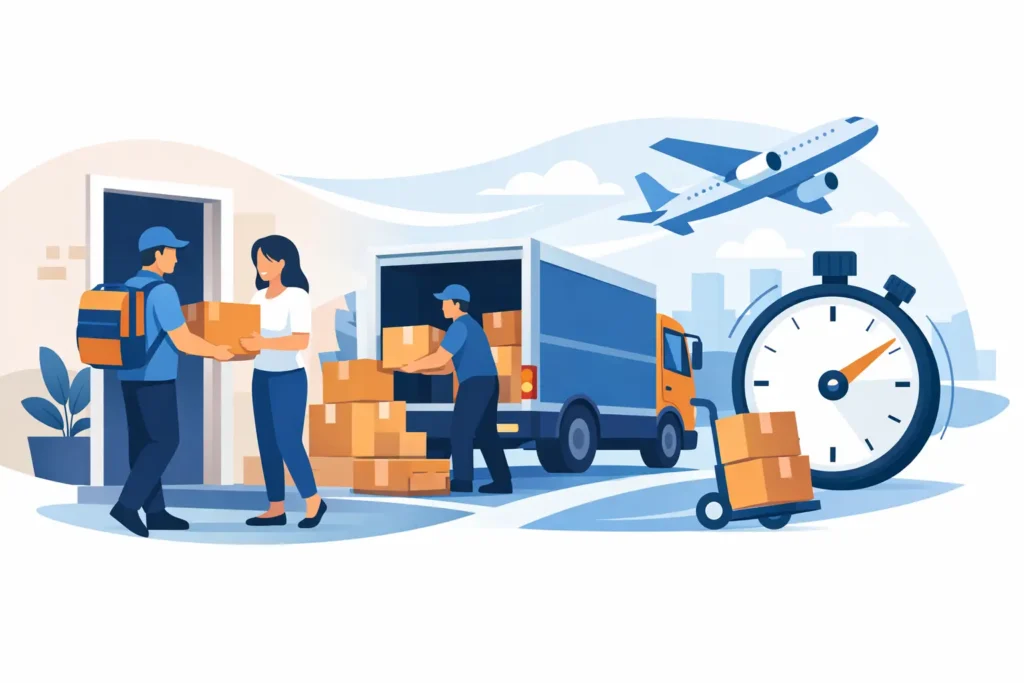
A late shipment rarely fails at the airport or seaport alone. More often, it slips somewhere between pickup, paperwork, customs clearance, local transport, and final handover. That is why door delivery cargo services matter so much for importers, exporters, and supply chain teams. When one logistics partner manages the full movement from origin door to destination door, there are fewer handoffs, clearer accountability, and less room for expensive surprises.
For businesses shipping to and from India and the UAE, that control can make a real difference. Trade lanes in this region move fast, but they also involve customs procedures, documentation checks, route planning, and local delivery coordination that need to work together. A door-to-door model is not just about convenience. It is about keeping cargo moving with fewer delays, tighter cost visibility, and better service for your customers.
What door delivery cargo services actually include
Door delivery cargo services cover the entire shipment journey, not just the line-haul freight. That usually starts with cargo collection from a factory, warehouse, supplier, or seller location. From there, the shipment may move by road to an airport, seaport, or consolidation point, then continue by air, ocean, or land freight depending on urgency, cargo type, and destination.
The service also includes the coordination that many businesses struggle to manage internally. That can mean export documentation, customs handling, import clearance, deconsolidation if the cargo is moving as LCL or groupage, and final-mile delivery to the consignee’s premises. For the shipper, the value is not only transport. It is having one operational chain instead of several disconnected vendors.
This matters even more when the cargo is specialized. Automotive shipments, project cargo, oversized freight, commercial inventory, and time-sensitive replenishment all require different handling methods. A provider offering door delivery must be able to adjust the movement plan based on cargo profile, not force every shipment into the same process.
Why businesses choose door delivery cargo services
The biggest reason is simple: fewer moving parts for the customer. If your team has to coordinate pickup, export clearance, freight booking, import documentation, and local delivery separately, every stage becomes a point of risk. Delays are harder to trace. Costs become fragmented. Responsibility gets blurred when something goes wrong.
A door-to-door setup creates one managed flow. That improves planning for procurement teams and gives importers and exporters a clearer delivery window. It also reduces the internal time spent chasing transporters, brokers, warehouses, and destination agents for updates.
There is also a commercial advantage. Faster, more predictable deliveries help protect inventory levels and customer commitments. For companies moving frequent cargo between India, the UAE, and international markets, reliability often matters as much as freight cost. A lower rate can lose its appeal quickly if a shipment gets stuck in clearance or misses a delivery deadline.
Where door-to-door works best – and where it depends
Door-to-door shipping is a strong fit for businesses that want operational simplicity. SMEs without a large in-house logistics team often benefit because they can outsource complexity to one experienced provider. Larger organizations use it as well, especially when they need dependable execution across recurring trade lanes or when shipping to locations where local delivery coordination is difficult.
It is particularly useful for commercial cargo with fixed delivery expectations, such as retail replenishment, manufacturing inputs, spare parts, and distributor shipments. It also works well for customers moving high-value items that need tighter handling oversight from origin to destination.
That said, door delivery is not always the lowest-cost option on paper. Some businesses with established customs teams, destination transport contracts, or free-zone operations may prefer to control part of the chain themselves. In those cases, port-to-port or airport-to-airport shipping can make sense. The better choice depends on your internal resources, cargo urgency, compliance needs, and tolerance for coordination risk.
Door delivery cargo services across India and the UAE
Shipping between India and the UAE demands local knowledge on both sides. Documentation standards, customs procedures, port and airport operations, and delivery conditions vary by shipment type and final destination. A provider that understands both markets can prevent common problems before they affect transit time.
For example, proper commodity classification, invoice accuracy, packaging compliance, and permit checks can determine whether a shipment clears smoothly or gets held for review. Final-mile delivery planning also matters. Delivering to an industrial area, retail location, bonded facility, or remote site requires different scheduling and access arrangements.
This is where integrated freight forwarding becomes valuable. A company with operational capability in both India and the UAE can coordinate pickup, freight mode, customs clearance, and delivery as one plan instead of treating each stage separately. For customers, that translates into better visibility and fewer disruptions.
The role of customs in door-to-door success
Customs is often the stage that decides whether a shipment stays on schedule. Even when freight space is booked correctly and cargo arrives on time, missing or inconsistent paperwork can create delays, storage charges, and delivery failures.
Strong door delivery cargo services are built around customs readiness. That includes checking commercial invoices, packing lists, certificates, HS codes, permits, and consignee details before the shipment moves. It also means understanding destination-specific import requirements and any restrictions tied to cargo type.
Businesses sometimes view customs clearance as a separate administrative step. In practice, it is part of the delivery promise. If your logistics provider treats customs as an afterthought, the entire door-to-door model becomes weaker. If customs handling is built into the shipping plan from the start, the shipment has a much better chance of reaching the consignee on time.
Choosing the right transport mode for door-to-door delivery
Door-to-door does not mean one transport mode fits every shipment. The right setup depends on the balance between speed, cost, cargo dimensions, and destination.
Air freight is usually the best choice for urgent shipments, high-value goods, and cargo with tight delivery windows. Ocean freight is often more economical for larger volumes and routine planning cycles, especially when timing is flexible. Land freight can be effective for regional movements and cross-border routes where road transport supports efficient final delivery.
In some cases, a multimodal plan works best. A shipment might move by ocean for cost efficiency and then continue by road for final delivery, or by air into a hub and then by truck to the consignee. The advantage of an experienced provider is not just access to modes. It is knowing when to combine them to meet service and budget goals.
What to look for in a door-to-door logistics partner
The right partner should be able to do more than arrange freight. Look for operational control across pickup, transport, customs, and delivery. Ask how shipment visibility is handled, who manages exceptions, and what happens if there is a documentation issue or a delivery-site problem.
Industry experience also matters. A provider moving general commercial cargo may not be equipped for vehicles, project cargo, fragile goods, or oversized freight. If your shipments have handling, lashing, insurance, or compliance requirements, that capability needs to be built into the service from the start.
It is also worth looking at geographic strength. Businesses trading between India and the UAE benefit from a logistics partner with real execution capability in both markets, not just agent-level coordination. Mass Freight Forwarding supports this kind of end-to-end movement by combining freight expertise, customs handling, and local delivery coordination into one managed solution.
A practical way to reduce shipping friction
Door delivery cargo services are valuable because they remove avoidable friction from the shipping process. They give businesses one chain of responsibility from origin to destination, which helps reduce delays, control costs, and improve planning. For importers, exporters, and supply chain managers working across India, the UAE, and international markets, that kind of structure can protect both operations and customer commitments.
If your current shipping model depends on too many handoffs, too much manual follow-up, or too many unknowns at customs and delivery, it may be time to simplify the chain. The best logistics setup is not always the cheapest first quote. It is the one that gets your cargo where it needs to be, when it needs to be there, with fewer problems along the way.
