
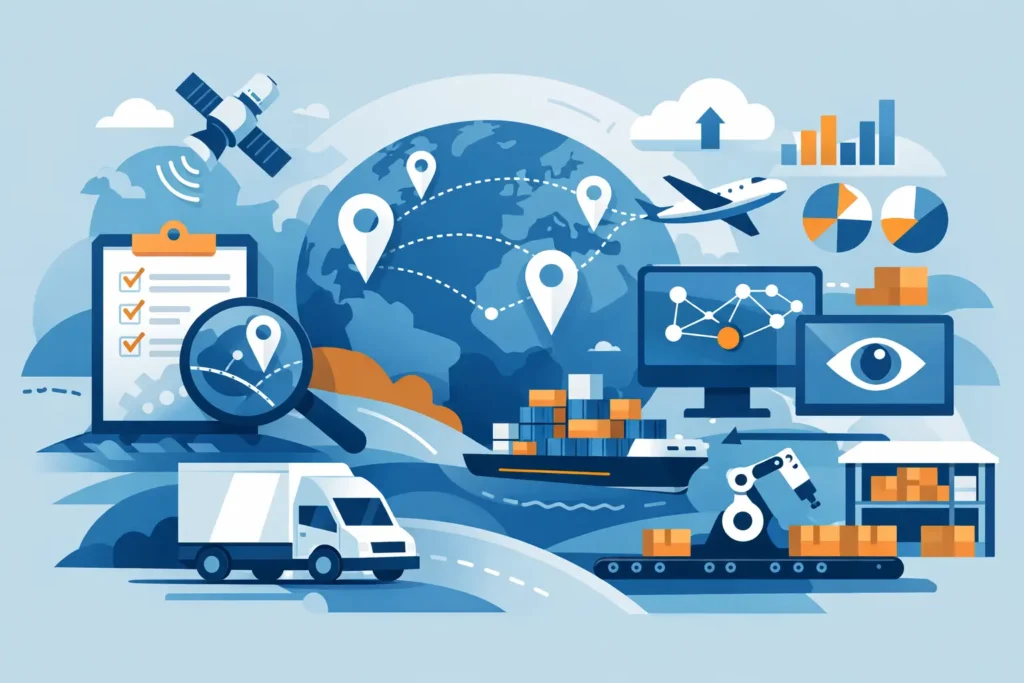
A shipment looks on schedule until it reaches a port hold, misses a customs document check, or sits in a transshipment hub with no clear status update. That gap between what was planned and what is actually happening is why supply chain visibility trends matter so much right now. For importers, exporters, and supply chain managers moving cargo through India, the UAE, and global trade lanes, visibility is no longer just tracking a container on a map. It is about making faster decisions before delays turn into extra cost.
Why supply chain visibility trends are changing fast
The pressure on logistics teams has changed. Customers expect accurate delivery windows, finance teams want tighter inventory control, and operations teams need fewer surprises at ports, airports, and border checkpoints. At the same time, supply chains have become more fragmented. A single shipment may involve multiple carriers, a freight forwarder, customs brokers, warehouse operators, and inland transport providers.
That complexity makes basic milestone updates less useful than they used to be. Businesses now want context. If cargo is delayed, they want to know why, how long the delay may last, and what can be done next. This is where current visibility trends stand apart from older tracking models.
1. Visibility is moving from location tracking to event intelligence
For years, visibility often meant checking whether cargo had departed, arrived, or cleared. That is still necessary, but it is not enough for companies trying to control lead times and customer commitments. The stronger trend is event intelligence – visibility built around operational exceptions.
This means alerts tied to meaningful events such as gate-out delays, customs inspections, document mismatches, missed feeder connections, or warehouse receiving bottlenecks. For a business importing machinery into the UAE or exporting consumer goods from India, this kind of visibility is far more useful than a simple status line.
The trade-off is that better event visibility depends on cleaner data from more partners. If even one handoff point reports late or inconsistently, the full picture can weaken.
2. Predictive ETA is becoming more valuable than static milestones
A posted arrival date is only helpful if it reflects real operating conditions. One of the most important supply chain visibility trends is the shift toward predictive ETA models that adjust based on congestion, route changes, carrier performance, weather, and customs patterns.
For supply chain managers, predictive ETA supports planning across procurement, warehouse labor, and downstream delivery. If a container expected into Jebel Ali or Nhava Sheva slips by two days, that affects transport bookings, production schedules, and customer updates. A forecast that changes early is more valuable than a late confirmation of delay.
Still, predictive tools are not magic. Their accuracy depends on data quality, lane history, and the type of shipment. Standard containerized freight may be easier to predict than project cargo or multi-stop inland movements.
3. Customs visibility is getting the attention it deserves
In many international movements, the biggest blind spot is not the ocean leg or air transit. It is customs readiness. A shipment can be physically close to delivery and still face costly delay because of classification issues, missing paperwork, permit requirements, or valuation questions.
That is why customs-stage visibility is becoming more central. Businesses want to know whether documents have been submitted, whether clearance is pending review, whether there is an examination risk, and whether duty or compliance issues could affect release.
This matters even more on trade lanes where timing is sensitive and paperwork accuracy has a direct impact on cargo release. For businesses shipping between India and the UAE, visibility into customs progress can prevent avoidable storage, demurrage, and disruption to onward delivery.
4. Inventory visibility is being tied more closely to freight visibility
Many companies still treat transport visibility and inventory visibility as separate systems. That split creates planning problems. If a procurement team knows what is on order but not what is realistically arriving, stock decisions become less reliable.
A clear trend is the connection of in-transit freight data with inventory planning. Businesses want to see not only where the shipment is, but what that means for stock availability, replenishment timing, and customer fulfillment risk. This is especially relevant for companies carrying fast-moving goods, seasonal products, spare parts, or production inputs.
The practical value is obvious. If a shipment of components is delayed at origin, the business can adjust allocations or sourcing earlier. But this integration usually requires coordination across systems and departments, which can be harder than it sounds.
5. Multi-party visibility is replacing single-provider reporting
One freight provider may handle a large part of the movement, but international shipping rarely sits with one party from start to finish. There may be a feeder carrier, a mainline carrier, a terminal, a transporter, a warehouse, and a customs authority involved. As a result, customers increasingly expect visibility that reflects the full chain rather than one provider’s segment.
This is one of the more practical supply chain visibility trends because it changes how companies evaluate logistics support. They are looking for partners who can coordinate updates across touchpoints and translate fragmented activity into one usable view.
That does not always mean a perfect live feed from every participant. In reality, some lanes and service modes still depend on manual updates at critical moments. What matters is whether the reporting is timely, accurate, and actionable when exceptions happen.
6. Visibility is becoming a customer service tool, not just an operations tool
Operations teams have always needed shipment status. Now sales teams, account managers, and end customers expect the same clarity. Visibility is increasingly tied to service quality because delivery uncertainty affects trust.
For example, if an exporter can proactively tell a buyer that cargo has cleared, transferred, and is on track for final delivery, the conversation stays controlled. If the buyer has to ask repeatedly for updates, confidence drops fast. This is particularly true for high-value cargo, automotive shipments, project freight, and time-sensitive commercial goods.
The shift here is subtle but important. Visibility is no longer just about internal management. It supports customer communication, helps manage expectations, and reduces friction when schedules change.
7. Exception management is becoming more important than more data
Many businesses already have access to large volumes of shipment data. The real problem is not a shortage of information. It is knowing which update deserves attention right now.
That is why exception management is one of the strongest trends in the market. Instead of flooding teams with every movement update, better visibility programs highlight the events that require action – a missed connection, a customs hold, a discrepancy in cargo documents, or a delivery risk tied to port congestion.
For busy logistics teams, this can improve response time and reduce wasted effort. But there is a balance to strike. If exception thresholds are too sensitive, teams end up chasing noise. If they are too broad, important warnings get missed.
What these trends mean for importers and exporters
The companies that benefit most from these shifts are not necessarily the ones with the most advanced technology stack. They are the ones that use visibility to make operational decisions earlier. That may mean rerouting cargo, adjusting warehouse schedules, preparing customs documents sooner, or warning customers before a delay affects delivery commitments.
It also means choosing logistics partners that understand visibility as part of execution, not as an add-on. Accurate updates depend on real operational control, strong documentation flow, customs knowledge, and communication across origin, transit, and destination points. For trade lanes involving India and the UAE, those details often matter more than a polished dashboard.
Mass Freight Forwarding works in the kind of environment where this matters every day – cross-border shipments, customs coordination, multimodal movement, and specialized cargo that cannot afford unclear handoffs.
How to respond to supply chain visibility trends without overcomplicating your process
The smartest response is usually a focused one. Start by identifying where your current blind spots create the most cost. For some businesses, it is customs status. For others, it is delivery ETA accuracy or poor coordination between freight arrival and warehouse planning.
Then ask a practical question: what update would help you act sooner? That answer will point to the visibility model you actually need. A high-volume importer may need better exception alerts. A project cargo shipper may need tighter milestone reporting and direct communication. A distributor may care most about linking in-transit stock to inventory planning.
The goal is not to collect more screens or more notifications. It is to reduce uncertainty at the moments that affect cost, service, and delivery performance.
The supply chain will never be fully predictable, especially across international trade lanes. But with the right visibility approach, it becomes far easier to spot problems early, respond with confidence, and keep cargo moving with fewer surprises.
