
A delayed container, a missing customs document, or the wrong mode of transport can turn a profitable shipment into an expensive problem. That is why so many importers, exporters, and supply chain teams ask the same question: what is freight forwarding, and where does a freight forwarder actually fit into the shipping process?
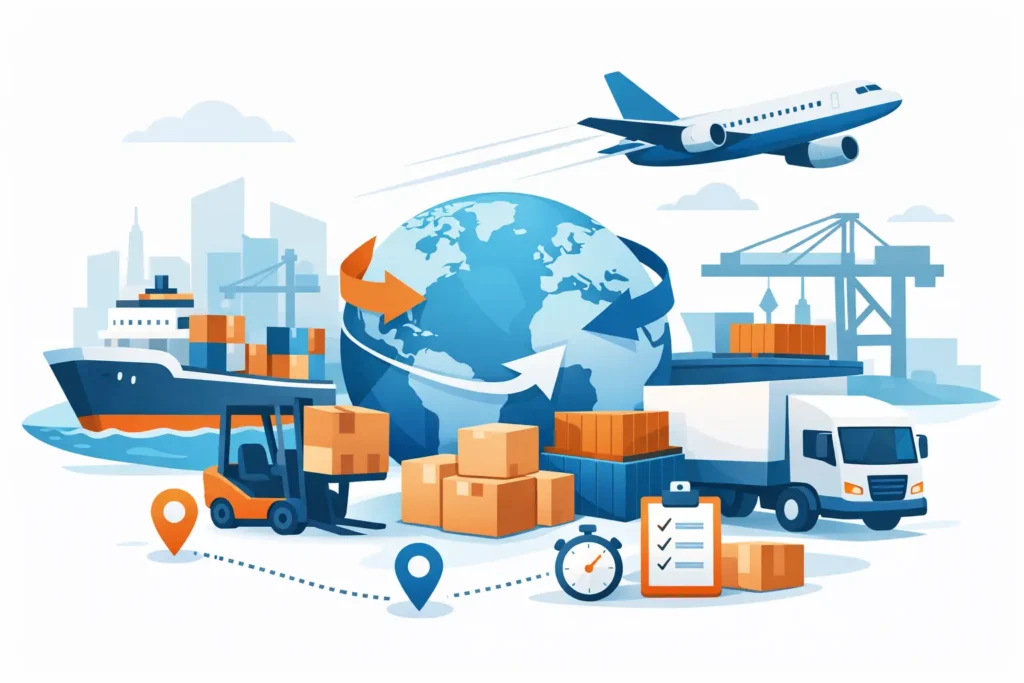
Freight forwarding is the coordination and management of cargo movement from one point to another using one or more transportation modes. A freight forwarder does not usually move the cargo with its own trucks, vessels, or aircraft. Instead, it plans the shipment, books space with carriers, manages paperwork, helps with customs, and keeps the shipment moving on schedule.
In practical terms, a freight forwarder acts as the operational link between shippers, carriers, customs authorities, warehouses, and final delivery points. For businesses shipping to and from India, the UAE, and other international markets, that coordination can make the difference between a smooth supply chain and repeated delays.
What Is Freight Forwarding in Simple Terms?
If you think of international shipping as a chain of connected steps, freight forwarding is the service that keeps those steps aligned. It covers route planning, carrier selection, freight booking, documentation, customs coordination, cargo handling, and delivery support.
A forwarder’s role is especially valuable when a shipment crosses borders. Once cargo moves internationally, the process becomes more than transport. It involves commercial invoices, packing lists, HS codes, customs rules, port procedures, transit schedules, and sometimes special handling for oversized, high-value, or time-sensitive cargo.
That is why freight forwarding is not just about getting goods from origin to destination. It is about managing risk, cost, compliance, and timing throughout the shipment lifecycle.
What a Freight Forwarder Actually Does
The scope of work depends on the shipment, but most freight forwarding services begin with planning. A forwarder reviews the cargo type, volume, dimensions, origin, destination, urgency, and budget. Based on that, it recommends whether air freight, ocean freight, land freight, or a multimodal solution makes the most sense.
For example, air freight may be the right choice for urgent cargo, expensive electronics, or spare parts needed to avoid production downtime. Ocean freight is often more economical for heavy, non-urgent, or large-volume shipments. Land freight may support regional movement after arrival, while a combined solution might move cargo by sea into the UAE and then by road to its final destination.
Once the route is chosen, the forwarder books cargo space with the carrier and coordinates collection, consolidation if needed, and movement to the port, airport, or warehouse. It also prepares or checks shipping documents and aligns customs clearance requirements. If issues arise, such as port congestion, a missed vessel cutoff, or a document mismatch, the forwarder works to resolve them before they become larger disruptions.
This is where experience matters. Freight forwarding is straightforward when everything goes to plan. The real value shows up when conditions change and the shipment still needs to arrive safely and on time.
Freight Forwarding vs. Shipping Line vs. Customs Broker
These roles are often confused, especially by businesses new to cross-border trade.
A shipping line, airline, or trucking company physically transports cargo. A customs broker focuses on customs entry, duties, and regulatory compliance. A freight forwarder coordinates the full shipment journey and may also arrange customs clearance through in-house capability or a licensed partner, depending on the market.
That distinction matters because businesses usually need more than transport alone. They need someone to connect booking, paperwork, compliance, warehousing, delivery, and communication across multiple parties. A forwarder becomes the single point of coordination.
Common Freight Forwarding Services
Freight forwarding can include far more than basic transport booking. Many businesses use forwarders for end-to-end logistics support because it reduces handoffs and improves accountability.
Depending on the shipment, services may include air freight, ocean freight FCL and LCL, inland trucking, door-to-door delivery, customs clearance, warehousing, cargo insurance, packing, cargo lashing, project logistics, and specialized handling for cars, break bulk, or RORO cargo.
Not every shipment needs every service. A regular importer may only need ocean freight and customs clearance. A project cargo shipper may need route surveys, lifting coordination, documentation support, and secure inland movement. The right setup depends on cargo type, destination rules, and delivery deadlines.
Why Businesses Use Freight Forwarders
The main reason is control. Global shipping has too many moving parts for most businesses to manage efficiently in-house, especially when shipments are recurring, cross multiple jurisdictions, or require specialized handling.
A good freight forwarder helps control cost by matching the right service level to the cargo. Paying for air freight on non-urgent cargo can waste budget. Choosing the cheapest sea option without considering free time, transit reliability, or destination charges can create larger downstream costs. Freight forwarding brings commercial and operational judgment into those decisions.
Businesses also use forwarders to reduce compliance risk. Customs delays are often caused by small documentation errors, inaccurate declarations, or poor coordination between shipper and consignee. Those are preventable issues, but only when someone is actively managing the shipment.
There is also a visibility benefit. Supply chain teams need updates they can act on, not just booking confirmations. When freight forwarding is handled well, customers know what has shipped, what is in transit, what needs customs attention, and what is scheduled for delivery.
What Is Freight Forwarding for India and UAE Trade?
For companies moving cargo between India and the UAE, freight forwarding often involves more than booking a container or pallet. These trade lanes can require close coordination around customs documentation, local handling, transit timelines, and final-mile delivery arrangements.
That is especially true for mixed cargo profiles. A business may import machinery components one week, export retail stock the next, and later arrange vehicle shipping or project cargo. Each movement has different handling needs, cost structures, and compliance points.
Working with a freight forwarder that understands both India and the UAE can simplify those operational gaps. Local customs familiarity, regional carrier access, and knowledge of route-specific challenges help reduce delays and improve planning accuracy. For businesses that need that kind of support, Mass Freight Forwarding provides freight forwarding and logistics services across these markets through https://www.massfreightforwarding.com.
How to Choose the Right Freight Forwarder
Not all forwarders offer the same depth of service. Some are strong in basic bookings but limited in customs or specialized cargo. Others may handle project logistics well but be less responsive for fast-moving commercial freight.
The right choice depends on your shipping profile. If you move high-volume cargo, you need consistency and pricing discipline. If you ship time-critical goods, responsiveness matters more than broad service menus. If your cargo is oversized, fragile, or high-value, handling capability and risk management should be at the center of the discussion.
Ask practical questions. Can the forwarder handle customs clearance in your target markets? Do they manage both origin and destination coordination? Can they support LCL, FCL, air, and land freight when your needs shift? Are they experienced with your cargo type, whether that is automotive, industrial equipment, retail inventory, or project cargo?
Price matters, but it should not be the only filter. A lower quote can become more expensive if communication is poor, documentation is mishandled, or shipment planning is weak.
When Freight Forwarding Adds the Most Value
Freight forwarding is especially useful when shipments are international, time-sensitive, regulated, or operationally complex. It also adds value when businesses are scaling and need a more dependable logistics structure without building a large in-house team.
For a small exporter, a forwarder provides access to shipping expertise that would otherwise be difficult to maintain internally. For a larger supply chain team, the forwarder becomes an execution partner that supports lane planning, exception handling, and ongoing cargo movement.
It is not a one-size-fits-all service. Some businesses need full door-to-door management. Others need a forwarder only for specific lanes or cargo types. The best setup is the one that aligns service scope with actual operational need.
Freight forwarding works best when it feels predictable. Your cargo is booked correctly, your documents are in order, your customs process is prepared, and your delivery path is clear before the shipment moves. That kind of structure gives businesses room to focus on purchasing, sales, and customer commitments instead of chasing containers, calls, and corrections.
