
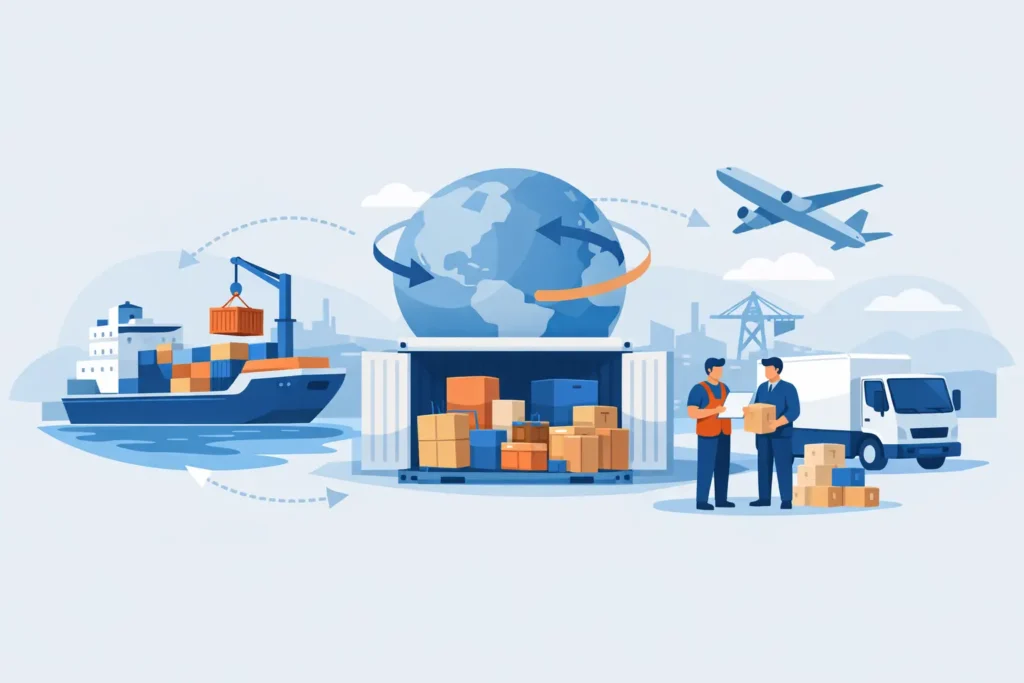
If you are shipping too much cargo for parcels but not enough to fill a full container, what is LCL groupage shipping becomes a very practical question. For importers, exporters, and supply chain teams moving freight between India, the UAE, and other global markets, LCL can be the difference between overpaying for unused container space and keeping inventory moving at a manageable cost.
LCL stands for Less than Container Load. Groupage shipping means multiple shippers share space in one ocean container. Instead of booking an entire container for your cargo alone, your shipment is consolidated with goods from other customers that are heading to the same destination or route.
That sounds simple, but the real value of LCL groupage shipping is in how it balances cost, flexibility, and transit planning.
What is LCL groupage shipping and how does it work?
LCL groupage shipping is a freight method where smaller shipments from different shippers are combined into one container at origin, moved by sea, then separated again at destination. Each shipper pays for the space their cargo uses rather than the cost of the full container.
The process usually starts with cargo delivery to a consolidation warehouse, also called a CFS or container freight station. There, the freight forwarder measures the cargo, checks packaging, prepares export documentation, and groups compatible shipments into one container. Once the container arrives at the destination port, it is moved to a deconsolidation facility where each shipment is separated and prepared for customs clearance and final delivery.
This model works well for businesses that ship regularly in smaller volumes, for companies testing new markets, and for buyers who do not want to wait until enough stock accumulates to justify a full container load.
When LCL makes more sense than FCL
The main alternative to LCL is FCL, or Full Container Load. With FCL, one shipper uses the entire container, whether it is fully packed or not.
LCL usually makes more sense when your cargo volume is relatively low. If you only have a few pallets, cartons, or crates, paying only for the cubic meters you use can be far more economical than booking a 20-foot or 40-foot container. It also helps businesses ship more frequently, which can reduce storage pressure and support better inventory flow.
That said, lower volume does not always mean LCL is the right option. If cargo is urgent, highly fragile, oversized, or close to the volume threshold where FCL pricing becomes competitive, the better choice can change. Transit speed, handling sensitivity, and route conditions all matter.
For many importers and exporters, the decision comes down to a trade-off. LCL is often more cost-efficient for smaller loads, while FCL can offer faster handling, fewer touchpoints, and in some cases lower risk of delay.
The biggest benefits of LCL groupage shipping
The first benefit is cost control. You are not paying for empty container space, which is especially useful for SMEs, seasonal buyers, and businesses with variable order sizes.
The second is flexibility. LCL allows you to move cargo as needed instead of waiting to build a full-container shipment. That can help maintain stock availability, support trial orders, and improve cash flow by spreading out shipping spend.
The third is market access. Companies expanding into the UAE, India, or other trade lanes often use LCL to start small and test demand before increasing shipment size. It lowers the entry barrier for international shipping.
There is also operational convenience when managed by an experienced forwarder. Consolidation, documentation, customs coordination, and delivery planning are handled in one workflow, which reduces friction for the shipper.
The trade-offs businesses should understand
LCL is useful, but it is not automatically the best option in every case.
Because multiple shipments are packed and unpacked together, LCL cargo goes through more handling than FCL. That can increase the importance of strong packaging, accurate labeling, and clear cargo details. If cartons are weak or palletization is poor, the chance of damage rises.
Transit can also be less direct. Your cargo may need to wait for the consolidator to build the container at origin, and once it arrives, deconsolidation and destination handling can add time before release. For supply chain managers with tight delivery windows, that extra time should be planned for rather than treated as an exception.
There are also additional charges to consider. While LCL can lower the base freight cost for smaller cargo, fees such as origin handling, destination handling, documentation, CFS charges, customs clearance, and local delivery still affect the final landed cost. A shipment that looks cheaper on freight alone may not stay cheaper after all charges are included.
What kind of cargo is suitable for LCL?
LCL groupage shipping is commonly used for general cargo, cartonized goods, palletized shipments, spare parts, retail stock, non-hazardous industrial products, and many commercial shipments that do not require a dedicated container.
It is especially practical for repeat shipments in moderate quantities. A distributor replenishing stock every few weeks, a manufacturer importing components, or an exporter serving smaller overseas buyers may find LCL a strong fit.
Still, cargo type matters. Hazardous goods, temperature-sensitive products, high-value items, and cargo with unusual dimensions may need special planning or may be better suited to other shipping methods. Compatibility with other cargo in the container is also part of the equation. Not every shipment should be grouped with every other shipment.
Costs in LCL shipping
LCL pricing is usually based on volume, often calculated in cubic meters, and sometimes on chargeable weight depending on the route and carrier structure. The larger your shipment, the more space you pay for.
But the freight rate is only one piece of the total cost. In real shipping decisions, importers should look at the full door-to-door picture. That includes pickup, warehousing if needed, consolidation, export customs documentation, ocean freight, destination handling, import clearance, duties and taxes where applicable, and final delivery.
This is where quote comparisons can become misleading. One provider may show a lower ocean rate but leave significant destination charges outside the main estimate. Another may price the shipment more transparently from the start. For budget planning, the more useful question is not just what the LCL rate is, but what the all-in shipment cost will be.
Timing, transit, and customs considerations
LCL transit time is influenced by more than the vessel schedule. Consolidation cut-off dates, port handling, customs release, and deconsolidation timelines all affect when cargo is actually available for delivery.
On routes involving India and the UAE, customs documentation accuracy is especially important. Invoice details, HS classification, packing list information, cargo descriptions, and consignee data all need to align. Small document errors can create delays that cancel out the planning advantage of frequent smaller shipments.
This is why experienced forwarding support matters. A forwarder that understands both origin and destination procedures can help prevent avoidable hold-ups, especially on cross-border trade lanes where documentation and compliance need close attention.
How to know if LCL is right for your business
A good rule is to look at shipment volume, urgency, cargo type, and the cost of waiting. If your shipment is too small for FCL, your lead time is manageable, and your packaging is suitable for shared-container movement, LCL is often a strong option.
It also works well when inventory strategy favors more frequent replenishment instead of larger, less frequent orders. Businesses trying to control warehouse space, preserve cash flow, or respond to changing demand often benefit from that flexibility.
If your cargo is time-critical, highly sensitive, or large enough that FCL is close in total cost, then the calculation changes. In those cases, paying more for a dedicated container may bring operational savings elsewhere.
For businesses shipping to and from India and the UAE, the best results usually come from treating LCL as a planned logistics tool rather than a fallback option. With the right consolidation schedule, accurate paperwork, and realistic transit expectations, it can be a dependable and cost-effective part of an international shipping strategy.
Mass Freight Forwarding supports importers and exporters that need this kind of practical balance – reliable movement, customs coordination, and shipping solutions that fit the cargo instead of forcing the cargo into the wrong model.
If you are weighing LCL against other freight options, the smartest next step is not to ask which method is cheapest in general. It is to ask which method fits your cargo, route, timeline, and total landed cost most accurately.
